Common Objections
Common Objections
Common Objections

Catholics believe baptism is magic.
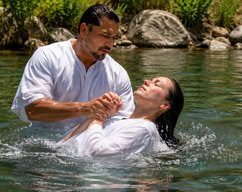
Some Protestants object to the Catholic teaching that baptism actually washes away sins and gives us new life in Christ. They argue that water can’t possibly do those things, and that attributing such powers to baptism amounts to treating it as magic.
But Catholics don’t believe there’s anything magical about baptismal water. It’s ordinary water. The power comes from God, not from the water itself.
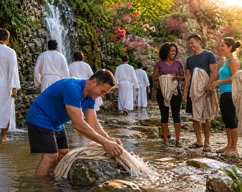
Consider what happened when Jesus healed a man who had been blind from birth. He made mud with his saliva, put it on the man’s eyes, and told him to wash in the Pool of Siloam. The man obeyed, washed, and came back seeing (John 9:1–7).
Was the mud magical? Was there something special about the water in the pool? Of course not. Jesus was the one who healed the man. But he chose to accomplish that healing through physical means.
And that’s hardly the only example. When Naaman was cured of leprosy, God required him to wash seven times in the Jordan River (2 Kings 5:10–14). The Jordan wasn’t a magical river. God simply chose to use its water as the means of healing him.
Why should baptism be any different?
Jesus told Nicodemus that we must be “born of water and the Spirit” (John 3:5). Peter told the crowd at Pentecost to repent and be baptized for the forgiveness of their sins (Acts 2:38). Ananias told Paul, “Get up, be baptized and wash your sins away, calling on his name” (Acts 22:16).
And Peter couldn’t have been more explicit:
Baptism, which corresponds to this, now saves you, not as a removal of dirt from the body but as an appeal to God for a clear conscience, through the resurrection of Jesus Christ (1 Peter 3:21).
Notice that Peter doesn’t attribute any special power to the water. He connects baptism’s saving effect to the resurrection of Jesus Christ.
Nor does the Catholic Church teach that baptism works like a magic spell, independently of God or regardless of the recipient’s disposition. Adults must approach baptism with faith and repentance. And although infants cannot yet make a personal profession of faith, their baptism is a gift of God’s grace, not an act of magic.
There’s an important distinction here. Magic attempts to manipulate supernatural power. A sacrament is an action through which God freely gives his grace. We don’t control God by baptizing someone. We’re doing what Christ commanded, trusting him to accomplish what he promised.
The real question isn’t whether water has the power to forgive sins. Catholics agree that it doesn’t.
The question is whether God can use water to forgive sins.
And if Scripture tells us that he does, why should we object?

Featured Articles
Copyright © 2024–[YEAR] Catholicoutlook.me