Common Objections
Common Objections
Common Objections


The Bible doesn't teach that Jesus founded a single, visible Church
Many evangelical Protestants believe that the Church Jesus founded isn’t any particular religious organization. It’s the invisible fellowship of everyone who has genuinely accepted Jesus Christ as Savior, regardless of which denomination they belong to.
Catholics agree that the Church has a spiritual dimension. But is that all it is? Or did Jesus also establish a visible Church, with identifiable leaders and the authority to govern its members?
When Jesus said he would establish a Church, he said to his disciple Simon, “I tell you that you are Peter, and on this rock I will build my church” (Matthew 16:18). We’ve discussed elsewhere the fact that Jesus was referring to Simon personally as the rock upon which he would build his Church. (See my article, “Peter, the Rock, and the Keys of the Kingdom”)
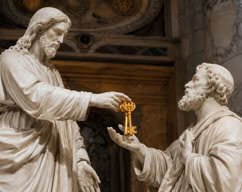
Jesus thus gave his Church a visible foundation in the person of Simon. Not only that, but he said to him, “I will give you the keys of the kingdom of heaven; whatever you bind on earth will be bound in heaven, and whatever you loose on earth will be loosed in heaven” (Matthew 16:19). Later, the other apostles were given a similar authority (Matthew 18:18).
What does this mean? According to Protestant New Testament scholar Craig S. Keener, these “were technical terms for the pronouncement of rabbis on what was and was not permitted (to bind was to forbid, to loose to permit). This verse (Matthew 16:19) therefore probably refers primarily to a legislative authority in the church.”1
This authority, given to Simon and the other apostles, was important because Jesus expected his followers to recognize and submit to the judgments of his Church. Consider what he said in Matthew 18:15–17:
“If your brother sins against you, go and show him his fault, just between the two of you. If he listens to you, you have won your brother over. But if he will not listen, take one or two others along, so that ‘every matter may be established by the testimony of two or three witnesses.’ If he refuses to listen to them, tell it to the church; and if he refuses to listen even to the church, treat him as you would a pagan or a tax collector” (emphasis added).
Notice that Jesus didn’t leave the matter to each believer’s personal judgment. He instructed his followers to bring unresolved disputes before the Church and to accept its judgment. Refusal to listen to the Church could even result in exclusion from the community.
After all, how could anyone bring a dispute before an invisible Church? Jesus was clearly describing a recognizable community capable of hearing a case and rendering a judgment.
Likewise, Hebrews 13:17 instructs Christians to “Obey your leaders and submit to their authority. They keep watch over you as men who must give an account.”
So far, then, we’ve seen that the Church Jesus founded was more than just an invisible communion of believers who were free to organize themselves however they saw fit. Christ established a visible leadership structure and gave its leaders genuine authority. The apostles, with Simon Peter occupying a position of special prominence, were entrusted with the responsibility of governing the Christian community, and believers were expected to submit to their judgments.
But did this authority extend beyond matters of personal conduct and discipline? Could the Church also settle disputes concerning what Christians were required to believe?
The Council of Jerusalem
An especially instructive example is found in Acts 15, where the Bible tells us:
Some men came down from Judea to Antioch and were teaching the brothers: “Unless you are circumcised, according to the custom taught by Moses, you cannot be saved.” This brought Paul and Barnabas into sharp dispute and debate with them (Acts 15:1–2).
Obviously, one side or the other was teaching a false doctrine. The question was whether Gentile converts were required to observe the Mosaic Law in order to be saved. This was no minor disagreement. It concerned the very conditions of salvation.
The way the Church resolved this dispute is instructive. Rather than leaving the question to each believer’s interpretation of Scripture or personal understanding of the Holy Spirit’s guidance, the matter was referred to the apostles and elders in Jerusalem:
Paul and Barnabas were appointed, along with some other believers, to go up to Jerusalem to see the apostles and elders about this question (Acts 15:2).
The apostles and elders gathered to consider the matter. They heard testimony, discussed the question, and examined the Scriptures. Peter spoke, Paul and Barnabas described what God had accomplished among the Gentiles, and James appealed to the words of the prophets.
Then the Church reached a decision. Gentile converts were not required to be circumcised or to observe the Mosaic Law as a condition of salvation. The apostles and elders issued a letter communicating their judgment, declaring:
“It seemed good to the Holy Spirit and to us not to burden you with anything beyond the following requirements” (Acts 15:28).
Notice the significance of those words. The council did not merely offer its opinion or suggest an interpretation that Christians were free to accept or reject. Its members understood themselves to be acting under the guidance of the Holy Spirit, and they issued an authoritative decision for the Church.
And how were Christians expected to respond?
As Paul and his companions traveled from town to town, “they delivered the decisions reached by the apostles and elders in Jerusalem for the people to obey” (Acts 16:4, emphasis added).
This is hardly the picture of a Church consisting merely of independent groups of believers, each free to determine Christian doctrine for itself.
The succession of Church authority
But what happened when the apostles died? Was this visible, authoritative leadership structure intended to disappear with them, leaving subsequent generations of Christians to govern themselves however they wished?
The New Testament gives us good reason to think otherwise.
When Judas abandoned his apostolic ministry, Peter explained that another man must take his place, quoting the Psalms: “His office let another take” (Acts 1:20). Matthias was subsequently chosen to take Judas’s place among the twelve apostles (Acts 1:15–26).
This demonstrates that an apostolic office could be entrusted to a successor. But we also find evidence that the apostles were establishing a continuing structure of Church leadership.
Acts 14:23 tells us that “Paul and Barnabas appointed elders for them in each church and, with prayer and fasting, committed them to the Lord, in whom they had put their trust.”
Paul likewise instructed Titus to appoint elders in every town (Titus 1:5). And when he addressed the elders of Ephesus, he reminded them that the Holy Spirit had made them overseers, entrusted with shepherding the Church of God (Acts 20:28).
These were not merely informal gatherings of believers. They were organized Christian communities with appointed leaders who exercised pastoral and governing responsibilities.
Even more significant is Paul’s instruction to Timothy:
And the things you have heard me say in the presence of many witnesses entrust to reliable people who will also be qualified to teach others (2 Timothy 2:2).
Notice the succession implied here. Paul had taught Timothy. Timothy was to entrust that teaching to reliable people, who would themselves be qualified to teach others. That’s four generations of Christian teachers, beginning with Paul himself. Clearly, the responsibility for preserving and transmitting apostolic teaching wasn’t supposed to end with the apostles.
The Church was to continue, and so was its teaching ministry.
The New Testament uses the terms elder and overseer in ways that sometimes overlap. By the beginning of the second century, however, we find the familiar threefold structure of bishops, presbyters, and deacons clearly described in the writings of Ignatius of Antioch.
But before turning to Ignatius, let’s consider an even earlier witness.
The testimony of the early Church
Writing near the end of the first century, Clement of Rome explained that the apostles had anticipated the need for continuing leadership and had provided for successors to those they appointed:
And our Apostles knew through our Lord Jesus Christ that there would be strife over the name of the bishop’s office. For this cause therefore, having received complete foreknowledge, they appointed the aforesaid persons, and afterwards they provided a continuance, that if these should fall asleep, other approved men should succeed to their ministration.2
Clement was writing at a time when the apostolic generation was only just passing away, yet he describes succession to ecclesiastical office not as a new development, but as something for which the apostles themselves had made provision. And this was more than a matter of preserving an administrative structure. The successors were entrusted with continuing the ministry of the Church.
Ignatius of Antioch, writing in the early second century and traditionally regarded as a disciple of the apostle John, described the visible organization of the Church in unmistakable terms:
Indeed, when you submit to the bishop as you would to Jesus Christ, it is clear to me that you are living not in the manner of men but as Jesus Christ, who died for us, that through faith in His death you might escape dying. It is necessary, therefore—and such is your practice—that you do nothing without the bishop, and that you be subject also to the presbytery, as to the Apostles of Jesus Christ our hope, in whom we shall be found, if we live in Him.3
And in the very next chapter, Ignatius wrote:
In like manner let everyone respect the deacons as they would respect Jesus Christ, and just as they respect the bishop as a type of the Father, and the presbyters as the council of God and college of Apostles. Without these, it cannot be called a Church.4
Could Ignatius have been any clearer? He considered the Church’s visible organization essential to its identity. And remember how early this testimony is. Ignatius was writing only a few decades after the death of the last apostle.
As sects and heresies arose in the post-apostolic era, the early Church appealed to apostolic succession as an important means of identifying authentic Christian teaching. When the Gnostics claimed to possess secret doctrines supposedly handed down from the apostles, the Church Fathers pointed instead to the public teaching preserved in churches whose leaders could trace their succession to the apostles.
Irenaeus of Lyons, who had been a disciple of Polycarp, himself traditionally regarded as a disciple of the apostle John, explained:
It is not necessary to seek the truth among others which it is easy to obtain from the Church; since the apostles, like a rich man [depositing his money] in a bank, lodged in her hands most copiously all things pertaining to the truth: so that every man, whosoever will, can draw from her the water of life. For she is the entrance to life; all others are thieves and robbers. …
True knowledge is [that which consists in] the doctrine of the apostles, and the ancient constitution of the Church throughout all the world, and the distinctive manifestation of the body of Christ according to the successions of the bishops, by which they have handed down that Church which exists in every place.5
Notice that Irenaeus did not separate apostolic succession from apostolic teaching. The two belonged together. The legitimate successors of the apostles were the guardians of the faith the apostles had publicly taught.
This is a very different understanding of the Church from the idea that anyone can establish an independent congregation, announce that he’s teaching the true Gospel, and thereby claim the same standing as churches whose leaders could trace their succession to the apostles.
And what did these early Christians call this visible, organized Church?
Ignatius of Antioch called it the Catholic Church. Writing to the Christians at Smyrna, he said:
Wherever the bishop appears, let the people be there; just as wherever Jesus Christ is, there is the Catholic Church.6
The word catholic comes from Greek and means universal. Ignatius used it to describe a Church whose visible organization included bishops, presbyters, and deacons.
Early Church historian J. N. D. Kelly, a Protestant, describes how the term came to be understood:
As regards [the name] “Catholic” … in the latter half of the second century at latest, we find it conveying the suggestion that the Catholic is the true Church as distinct from heretical congregations (cf., e.g., Muratorian Canon). … What these early fathers were envisaging was almost always the empirical, visible society; they had little or no inkling of the distinction which was later to become important between a visible and an invisible Church.7
That last observation is especially significant. The early Church Fathers certainly recognized the spiritual dimension of the Church, but they did not generally conceive of it as an invisible fellowship existing independently of the visible Christian community.
For them, the Church was a recognizable society with an identifiable faith, worship, and leadership.
That they may all be one
There is another important reason why Jesus would have established his Church this way: unity.
Throughout the New Testament, Christians are repeatedly instructed to preserve their unity. Paul wrote:
I appeal to you, brothers, in the name of our Lord Jesus Christ, that all of you agree with one another so that there may be no divisions among you and that you may be perfectly united in mind and thought (1 Corinthians 1:10).
Likewise, he warned believers to “note those who cause divisions and offenses, contrary to the doctrine which you learned, and avoid them” (Romans 16:17, NKJV).
In Galatians 5:19–21, Paul even warned that those who engage in “dissensions” (Greek: dichostasiai) and “factions” (Greek: haireseis) will not inherit the kingdom of God.
Clearly, unity was not merely an optional ideal. Christians were expected to preserve it, and divisions within the Church were treated as a serious matter.
But why was unity so important?
Jesus himself gives us the answer in his prayer to the Father:
“I have given them the glory that you gave me, that they may be one as we are one: I in them and you in me. May they be brought to complete unity to let the world know that you sent me and have loved them even as you have loved me” (John 17:22–23).
Notice the purpose of this unity: that the world may know that the Father sent Jesus.
The unity of Christians was intended to be a witness to the world that Jesus is who he claimed to be. But how can that unity serve as a convincing witness if Christians are divided into competing churches, teaching contradictory doctrines and recognizing different authorities?
Christians can sincerely love one another while disagreeing about what Christianity teaches. But love alone can't settle those disagreements. If one church teaches that baptism actually forgives sins while another teaches that it doesn't, both may be filled with sincere believers. But they can't both be teaching the truth about baptism. And without an authority they both recognize, how can the disagreement ever be resolved?
Certainly, Christians belonging to different denominations can share a genuine faith in Christ, cooperate in charitable works, and recognize one another as fellow believers. Such unity is real and valuable. But it does not eliminate their doctrinal divisions, nor does it provide a means of resolving those divisions authoritatively.
But if the unity Jesus prayed for was supposed to convince the world that the Father sent him, shouldn't it be a unity the world could actually see?
This brings us back to the question with which we began.
If Jesus intended his followers to remain united in faith, how would he have made that possible? Would he have left each Christian, or each independent congregation, to determine for itself what constituted authentic Christian doctrine? Or would he have provided his Church with a visible leadership structure, entrusted with preserving the apostolic faith and maintaining unity among his followers?
The evidence we’ve examined points strongly toward the latter.
Jesus appointed apostles and gave them authority. The apostles exercised that authority in governing the Church and settling doctrinal disputes. They established local leaders and entrusted others with the responsibility of preserving and transmitting their teaching. And the earliest post-apostolic Christian writers describe a visible Church governed by successors to the apostles.
The Church Jesus founded was never intended to be merely an invisible association of believers, with no continuing, authoritative leadership. It was, and remains, a visible society, “built upon the foundation of the apostles and prophets, Jesus Christ himself being the chief corner stone” (Ephesians 2:20).
And it is “the church of the living God, the pillar and ground of the truth” (1 Timothy 3:15).
__________
1 Craig S. Keener, The IVP Bible Background Commentary: New Testament (Downers Grove, IL: InterVarsity Press, 1993), 90.
2 Clement of Rome, First Letter to the Corinthians 44:1–2 (c. A.D. 96), translated by J. B. Lightfoot, in The Apostolic Fathers, edited by J. R. Harmer (London: Macmillan and Co., 1891). https://ccel.org/ccel/lightfoot/fathers/fathers.ii.i.html.
3 Ignatius of Antioch, Letter to the Trallians 2:1–3 (c. A.D. 110), in The Faith of the Early Fathers, vol. 1, edited and translated by William A. Jurgens (Collegeville, MN: Liturgical Press, 1970), 20.
4 Ibid., 3:1–2, 20–21. Emphasis added.
5 Irenaeus of Lyons, Against Heresies 3.4.1 and 4.33.8, translated by Alexander Roberts and William Rambaut, in Ante-Nicene Fathers, vol. 1, edited by Alexander Roberts, James Donaldson, and A. Cleveland Coxe (Buffalo, NY: Christian Literature Publishing Co., 1885).
6 Ignatius of Antioch, Letter to the Smyrnaeans 8:2, c. A.D. 110.
7 J. N. D. Kelly, Early Christian Doctrines (New York: Harper & Row, 1960), 190.
Featured Articles
Copyright © 2024–[YEAR] Catholicoutlook.me