Common Objections
Common Objections
Common Objections


Jesus is the foundation of the Church, so Peter can't be
There’s no question that Jesus Christ is the foundation of the Church. The apostle Paul explicitly tells us:
For no one can lay any foundation other than the one already laid, which is Jesus Christ (1 Corinthians 3:11).
Catholics believe that, too. But Catholics also believe that Peter is a foundation of the Church, because Jesus said:
And I tell you that you are Peter, and on this rock I will build my church, and the gates of Hades will not overcome it (Matthew 16:18).
So how can Peter be a foundation of the Church if Jesus is its real foundation? Isn’t that a contradiction?
Because both analogies come from Scripture, and Scripture can’t contradict itself, I’d have to say no.
But wait, it gets worse.
How many foundations does the Church have?
Consider what Paul wrote to the Christians at Ephesus:
Consequently, you are no longer foreigners and strangers, but fellow citizens with God’s people and also members of his household, built on the foundation of the apostles and prophets, with Christ Jesus himself as the chief cornerstone (Ephesians 2:19–20).
Notice that Paul doesn’t say the Church is built on Christ instead of the apostles. He says it’s built on the foundation of the apostles and prophets, with Christ as the chief cornerstone.
And in Revelation, John describes the heavenly Jerusalem:
The wall of the city had twelve foundations, and on them were the names of the twelve apostles of the Lamb (Revelation 21:14).
Twelve foundations! And each one bears the name of an apostle.
Apparently, the apostles can be foundations of the Church without diminishing Christ’s unique position as its ultimate foundation.1
If saying that Peter is a foundation of the Church contradicts 1 Corinthians 3:11, wouldn’t saying that all twelve apostles are foundations contradict it even more?
Yet that’s what Scripture says.
Different foundations, different senses
The apparent contradiction disappears when we recognize that Scripture uses the word foundation in more than one sense.
Christ is the foundation of the Church because everything about the Church depends on him. He’s its founder, its Savior, its head, and the source of its life and authority. Without Christ, there would be no Church.
The apostles, on the other hand, are foundations because Christ chose them to establish and govern his Church and to transmit his teachings to future generations.
Their authority isn’t independent of Christ. It comes from him.2
What did Jesus mean when he called Peter the rock?
When Jesus said, “You are Peter, and on this rock I will build my church,” he wasn’t suggesting that Peter would replace him as the Church’s ultimate foundation.
Jesus said, “I will build my church.”
It’s still Christ’s Church. He’s still the builder. He’s still the source of its authority.
But he’s telling Peter that he will have a particular role in that Church.3
And Jesus doesn’t stop there:
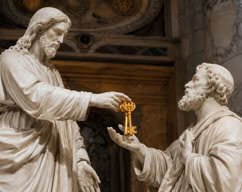
I will give you the keys of the kingdom of heaven; whatever you bind on earth will be bound in heaven, and whatever you loose on earth will be loosed in heaven (Matthew 16:19).
Notice who’s doing the giving. Jesus is.
Peter doesn’t seize authority for himself. Christ gives it to him.
The same is true when Jesus tells Peter to strengthen his brothers (Luke 22:31–32), and when he commands him three times to feed and care for his sheep (John 21:15–17).
Christ doesn’t surrender his authority when he entrusts responsibilities to Peter. He exercises his authority by doing so.
And there’s nothing unusual about that. Throughout Scripture, God accomplishes his purposes through people he chooses and commissions. Moses exercised authority over Israel without becoming a rival to God, and the apostles taught in Christ’s name without competing with Christ.
Why, then, should giving Peter a particular responsibility in the Church be understood as a challenge to Christ’s authority?
But isn’t Jesus the rock?
Yes. Scripture repeatedly describes God as a rock, and Paul specifically identifies Christ as the spiritual rock that accompanied Israel (1 Corinthians 10:4).
But Scripture also applies rock imagery to others.
For example, Isaiah tells the Israelites:
Look to the rock from which you were cut and to the quarry from which you were hewn; look to Abraham, your father, and to Sarah, who gave you birth (Isaiah 51:1–2).
Here Abraham is associated with the rock from which Israel was hewn. That doesn’t make Abraham God, nor does it diminish God’s position as Israel’s ultimate source and protector.4
Similarly, Jesus is called the shepherd of his people (John 10:11), yet he appoints Peter to shepherd his flock (John 21:15–17). Peter’s role doesn’t make Jesus any less the Good Shepherd.
And Jesus is called the light of the world (John 8:12), yet he tells his disciples, “You are the light of the world” (Matthew 5:14).
Nobody supposes that Jesus contradicted himself by calling his disciples something he had already called himself.
Why should the word rock be treated differently? The Bible isn’t limited to one person per metaphor.
What about Paul’s statement that no other foundation can be laid?
Let’s return to 1 Corinthians 3:11:
For no one can lay any foundation other than the one already laid, which is Jesus Christ.
But notice what Paul was talking about. Earlier in the chapter, he describes himself as a builder:
By the grace God has given me, I laid a foundation as a wise builder, and someone else is building on it (1 Corinthians 3:10).
Paul had established the Christian community at Corinth by preaching Jesus Christ. That’s the foundation he laid. His warning is that nobody can substitute some other foundation for the Gospel of Christ.5
He wasn’t denying that Christ could appoint apostles to foundational roles within his Church. In fact, Paul himself describes the apostles and prophets as the Church’s foundation in Ephesians 2:20.
The mistake is taking Paul’s statement about Christ being the foundation of the Christian faith and turning it into a prohibition against anyone else being described as a foundation in another sense.
The real question
The Catholic Church doesn’t teach that Peter replaces Christ as the foundation of the Church. It teaches that Christ established his Church and gave Peter a particular responsibility within it.
Scripture calls Christ the foundation of the Church. It also calls the apostles its foundation. And Jesus himself calls Peter the rock on which he will build his Church.
If those statements can all be true—and they must be, if Scripture doesn’t contradict itself—then the fact that Christ is the foundation of the Church can’t possibly prove that Peter isn’t also a foundation.
The question isn’t whether Jesus or Peter is the foundation of the Church. The question is what role Jesus gave Peter in the Church he was building.
And we can’t answer that question by denying that Jesus could have given him one.
__________
1 Second Vatican Council, Lumen Gentium (1964), §19. The Council describes the Church as established upon the apostles and Peter, with Christ himself as the supreme cornerstone. Official Vatican text.
2 Catechism of the Catholic Church, §§857–858. The Catechism explains that the Church is founded on the apostles, who were chosen and commissioned by Christ, and that their mission continues Christ’s own mission. Official Vatican text.
3 Catechism of the Catholic Church, §881; Second Vatican Council, Lumen Gentium, §22. Both explicitly identify Simon Peter as the rock of the Church and describe the responsibilities entrusted to him by Christ. Catechism, §881; Lumen Gentium, §22.
4 United States Conference of Catholic Bishops, New American Bible, Revised Edition, note on Isaiah 51:1. The note identifies the rock and quarry imagery as a reference to Israel’s ancestry. The following verse specifically identifies Abraham and Sarah. Isaiah 51 and accompanying notes.
5 United States Conference of Catholic Bishops, New American Bible, Revised Edition, notes on 1 Corinthians 3:5–4:5 and 3:10–11. The notes explain Paul’s discussion of the apostles as ministers through whom God works and his metaphor of building the Christian community. 1 Corinthians 3 and accompanying notes.
Featured Articles
Copyright © 2024–[YEAR] Catholicoutlook.me