Science and Faith
Science and Faith
Faith and Reason
Science and Faith
Science and Faith
Faith and Reason
Faith and Reason

Catholic Outlook

Catholic Outlook
Catholic Outlook
Geocentrism
————
The History of the Heavens
Ptolemy, Copernicus, and Tycho, and the evidence that proved which one was right
Once people figured out that Earth was round (about 500 BC), they assumed that it was stationary and that the objects they saw in the sky revolved around Earth once each day. That makes sense, because it conforms with what we observe. We can’t feel Earth move, so it makes sense to assume that it doesn’t. Likewise, we can see the objects in the sky move with our own eyes, so it makes sense to assume that they actually do move.
Eventually people noticed that five of the stars in the night sky moved relative to the other stars. They called them “planets,” from the Greek word πλανήτης (planētēs), meaning “wanderer.” For some reason the planets didn’t move in a steady, uniform way. They usually moved eastward, but sometimes they would slow down and stop, then actually move westward for a time before stopping again and resuming their eastward motion. The fancy name for this phenomenon is “retrograde motion.”
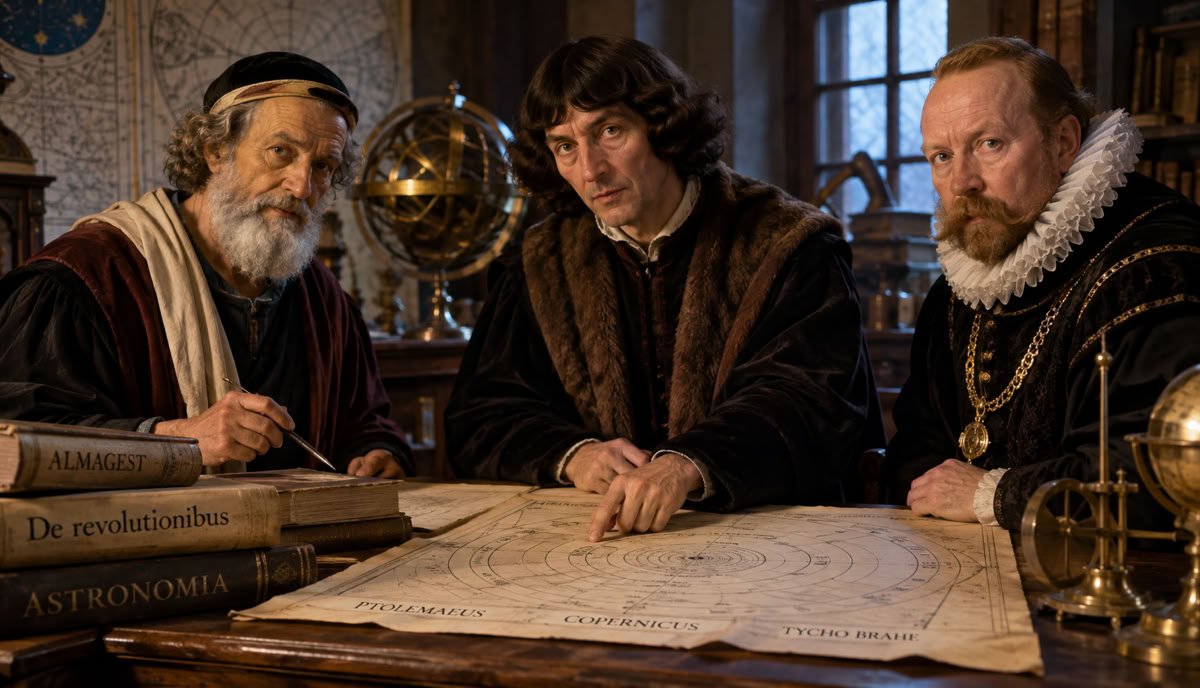
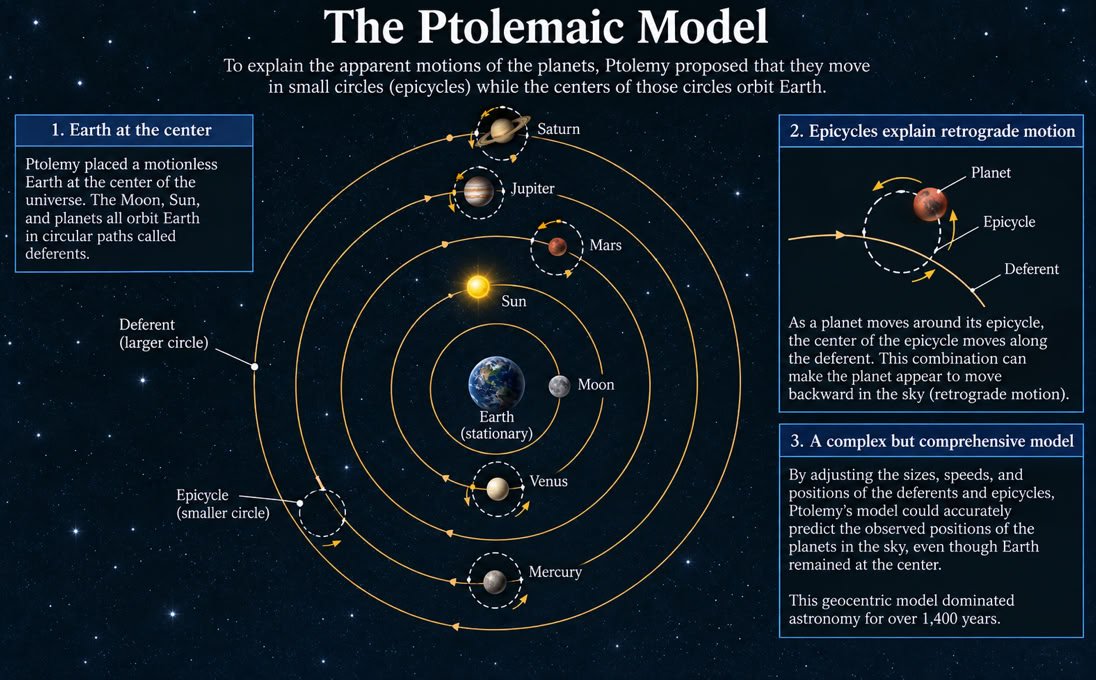
In the second century, Greco-Egyptian astronomer Claudius Ptolemy came up with a model of the solar system in which the Sun, Moon, planets and stars all revolve around a stationary Earth. In order to account for the observed retrograde motion of the planets, Ptolemy proposed that the planets move in small circles (called epicycles) as they complete much larger orbital circles (called deferents) around the Earth.
This system fit the observed motion of the celestial bodies, but it was somewhat convoluted.
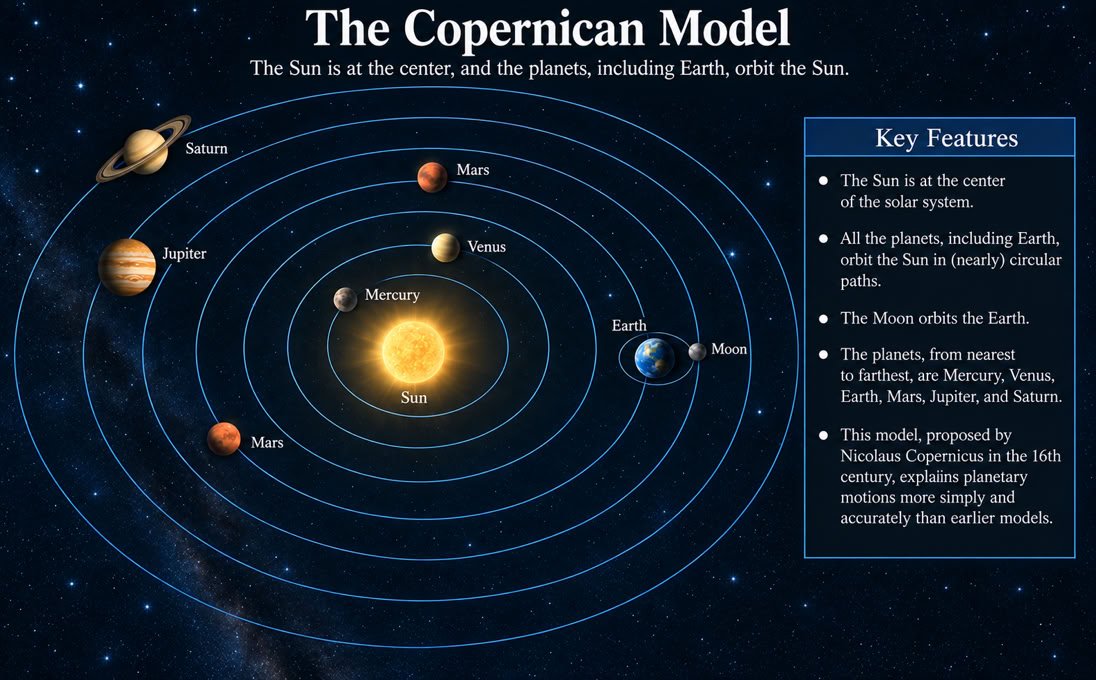
In the 16th century, Polish astronomer Nicolaus Copernicus grew dissatisfied with the Ptolemaic model of the solar system. He believed that the planets should orbit in uniform circles without a bunch of complicated epicycles. So, in 1543, just before his death, he proposed a model in which all the planets, include Earth, orbited the Sun. He also proposed that the apparent daily rotation of the heavens could be explained more simply if the heavens were stationary and Earth itself were rotating in the opposite direction.
His model had the advantage of physical and mathematical simplicity, and it accounted for the strange retrograde motion of the other planets. In his model, retrograde motion was an optical illusion caused by Earth either passing or being passed by the other planets as they moved in circular orbits around the Sun. It also accounted for the fact that the inner planets Mercury and Venus never strayed far from the Sun.
The Danish astronomer Tycho Brahe was impressed by aspects of the Copernican system, but he thought Earth was too big, too heavy, and too sluggish to be capable of the motion that Copernicus proposed. He also reasoned that if Earth were orbiting the Sun, we should be able to observe a slight shift in the nearby stars relative to more distant stars, a phenomenon called “stellar parallax.” Because Tycho wasn’t able to observe stellar parallax, he concluded that Copernicus was wrong about Earth orbiting the Sun.
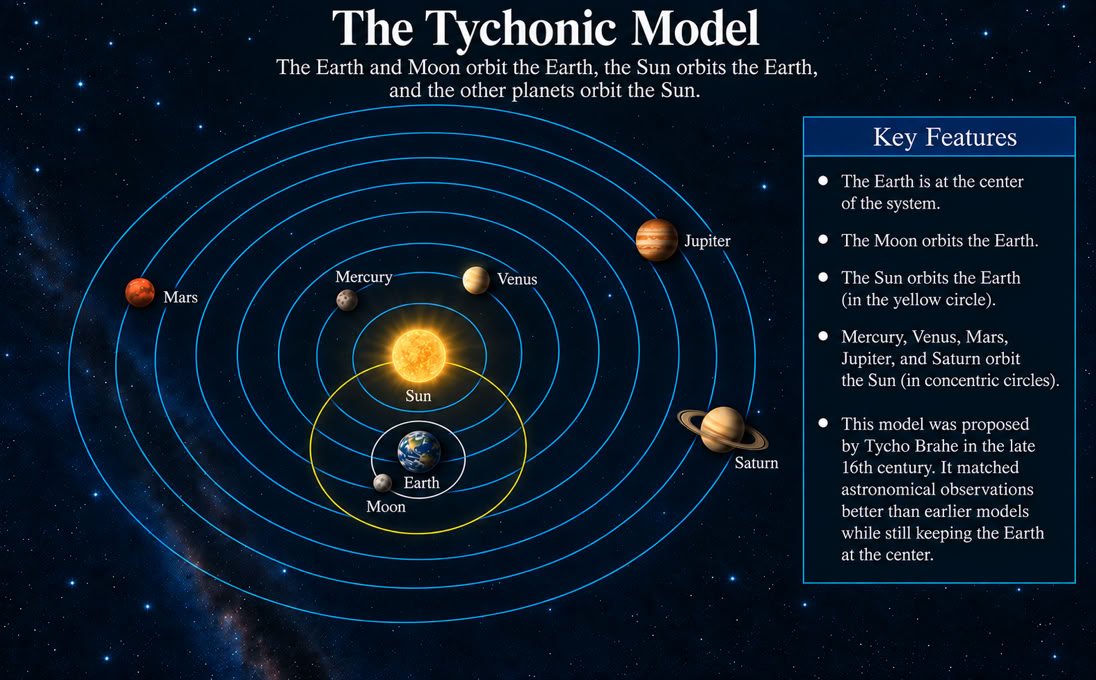
So, in 1588 Tycho proposed a model of the solar system in which all of the planets except Earth orbit the Sun, while the Sun orbits a stationary Earth. The Tychonic model preserved the mathematical elegance of the Copernican model while also preserving a stationary Earth.
Galileo Champions the Copernican Model
In 1609, after the death of Tycho and after the invention of the telescope, Italian astronomer Galileo Galilei began studying the night sky with a telescope, and his observations of the phases of Venus proved that at least Venus was orbiting the Sun. That disproved the old Ptolemaic model once and for all, leaving the Copernican and Tychonic models as the only viable alternatives.
Galileo favored the Copernican model with its rotating, Sun-orbiting Earth to the Tychonic system with its stationary Earth and rotating universe. But for all his bluster (and Galileo had a lot of bluster) he couldn’t come up with any solid proof that the Copernican model was correct.
He tried suggesting that the combination of Earth’s rotation about its axis and its revolving around the Sun caused parts of Earth’s surface to speed up and slow down, thus causing the oceans to slosh around like water in a bathtub and cause the tides we observe every day. But that theory was completely wrong, and it could only predict a single high tide each day instead of the two that we actually observe.
German astronomer Johannes Kepler, who had been Tycho’s assistant, noted that the timing of the tides was always synched with the phases of the Moon, and he correctly deduced that the tides were caused by the Moon exerting some sort of invisible force on Earth’s oceans. This was 70 years before Newton proposed his law of universal gravitation, so it’s understandable that Galileo was skeptical about the existence of such a force. He praised Kepler as an exceptional thinker, but ridiculed his lunar theory of the tides as an “occult” and childish idea.1
The Copernican Model Wins Out
It was actually Kepler, not Galileo, who began to turn the tide in favor of the Copernican model. Copernicus, like everyone else, assumed that the planets orbited in perfect circles. But Kepler discovered that they actually follow elliptical orbits, with the Sun at one focus of the ellipse. He also discovered that the planets moved faster as they got closer to the sun, and slower as the got farther away from it. These two observations (known as Kepler’s first and second laws) suggested that the sun was somehow responsible for planetary motion.
It was still possible to construct a mathematical model along the lines of the Tychonic model that accommodated Kepler’s observations, but it didn’t make sense to suppose that the five visible planets had their motion arranged around and controlled by the Sun, but Earth didn’t. It seemed more likely that the solar system was Sun-centered (“heliocentric”) and not Earth-centered (“geocentric”).
Newton Explains How the Planets Move
The real breakthrough that finally disqualified the Tychonic model came in 1687 when Isaac Newton published Philosophiæ Naturalis Principia Mathematica (Mathematical Principles of Natural Philosophy). Newton showed that the same simple laws of motion and gravitation could account for all manner of observed motion, including falling objects on earth, the Moon’s orbit, the planets’ orbits, the motion of comets, and Kepler’s laws.
Most importantly, Newton demonstrated that less massive objects orbit more massive objects. Therefore, the Sun, which accounts for a whopping 99.86 percent of the solar system’s mass, was the only object that could possibly be the center of the solar system. It would be physically impossible for the massive Sun and planets to orbit the minuscule Earth.
James Bradley Proves that Earth is Moving Through Space
With improvements in scientific instruments, direct observational confirmation of heliocentrism quickly followed. Just 40 years after Newton published the Principia, in 1727-28 English astronomer (and Anglican priest) James Bradley accidentally discovered the phenomenon of stellar aberration.
Ironically, Bradley and his friend Samuel Molyneux were actually trying to measure the stellar parallax that Tycho Brahe had been unable to observe. They were studying the star Gamma Draconis , and they did observe the star appear to shift its position, but it shifted in the opposite direction from what they expected.
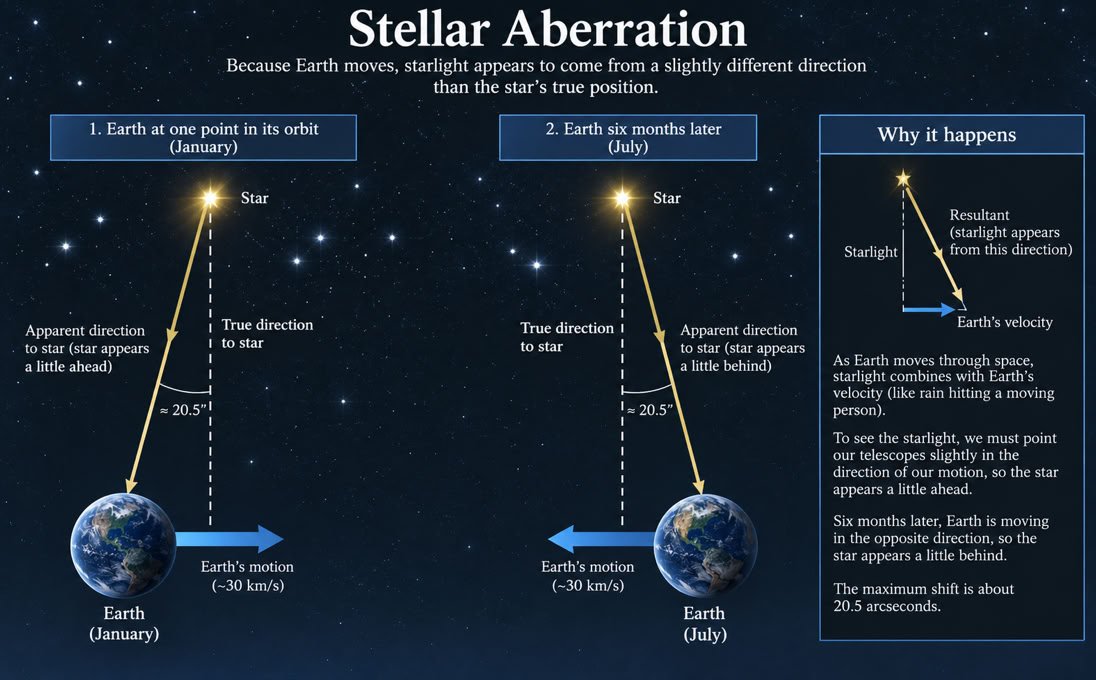
Bradley realized that the effect was being caused by the sideways speed of the Earth through space (approximately 30 km per second) and the finite speed of light (approximately 300,000 km per second). He realized that starlight takes a microscopically small but measurable amount of time to travel down a telescope tube. By the time the starlight travels from the objective to the eyepiece, the telescope has moved microscopically through space with Earth. An astronomer must therefore tilt the telescope slightly in the direction of Earth's motion for the light to reach the eyepiece properly aligned.
To better understand this effect, imagine that you’re standing in the rain on a windless day. The raindrops are falling straight down, you have to hold your umbrella directly over your head to stay dry. Now imagine that you start running. The raindrops are still falling straight down, but from your point of view they seem to come at you diagonally. You have to tilt your umbrella in the direction you’re moving in order to stay dry. That’s roughly analogous to how stellar aberration works.
Bradley’s accidental discovery of stellar aberration was the first direct, observational proof that Earth was moving through space.
Friedrich Bessel Proves That Earth Orbits the Sun
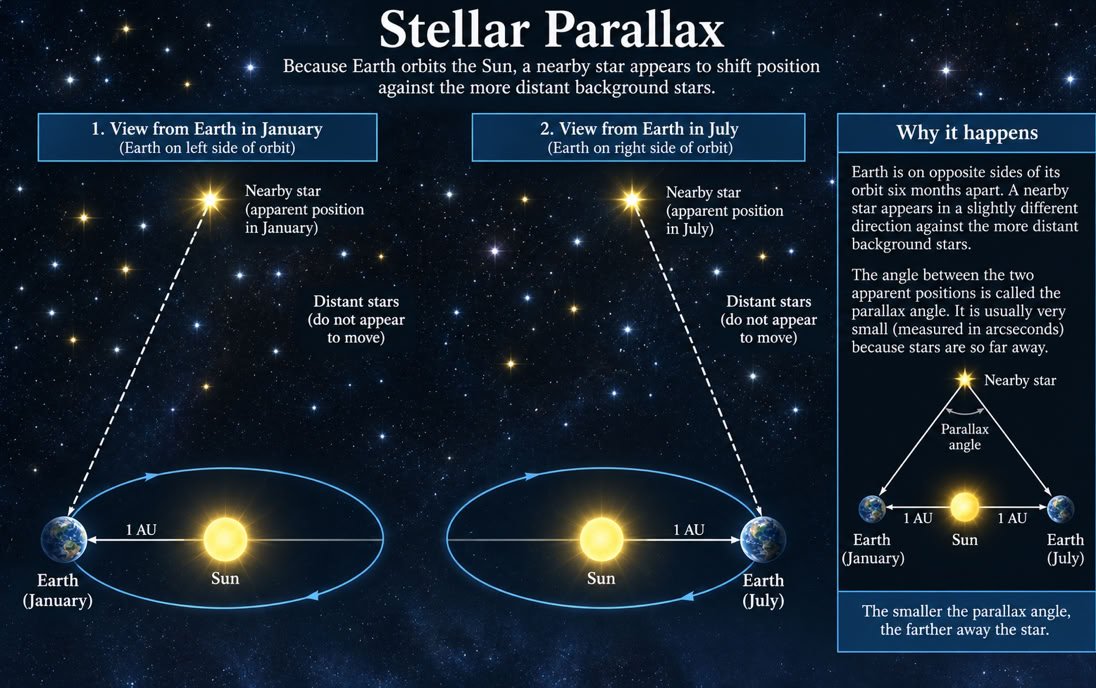
Tycho Brahe, Nicolaus Copernicus, and even the ancient Greek astronomer Aristarchus of Samos predicted that if Earth were orbiting the Sun a nearby star should appear to shift slightly relative to more distant stars as Earth moved around the Sun. The fact that they weren’t able to observe such apparent motion was taken as evidence against heliocentrism.
Copernicus theorized that perhaps the stars were so incredibly distant that their parallax was too small to detect. He turned out to be right. During the years 1837-1838, German astronomer Friedrich Bessel studied the star 61 Cygni with a Fraunhofer heliometer.2 Bessel hoped to observe a small back-and-forth displacement in the star’s apparent position that repeated in sync with Earth’s position around the Sun.
Bessel succeeded, finally demonstrating a direct geometrical proof of Earth’s orbit around the sun, a proof that astronomers had sought unsuccessfully for centuries. Bessel was able to measure a parallax of approximately 0.314 arcseconds, confirming Copernicus’ supposition that the effect was too small to be observed with the naked eye. This proved that Earth was not only moving through space, but orbiting the Sun.
Léon Foucault Proves That Earth Rotates
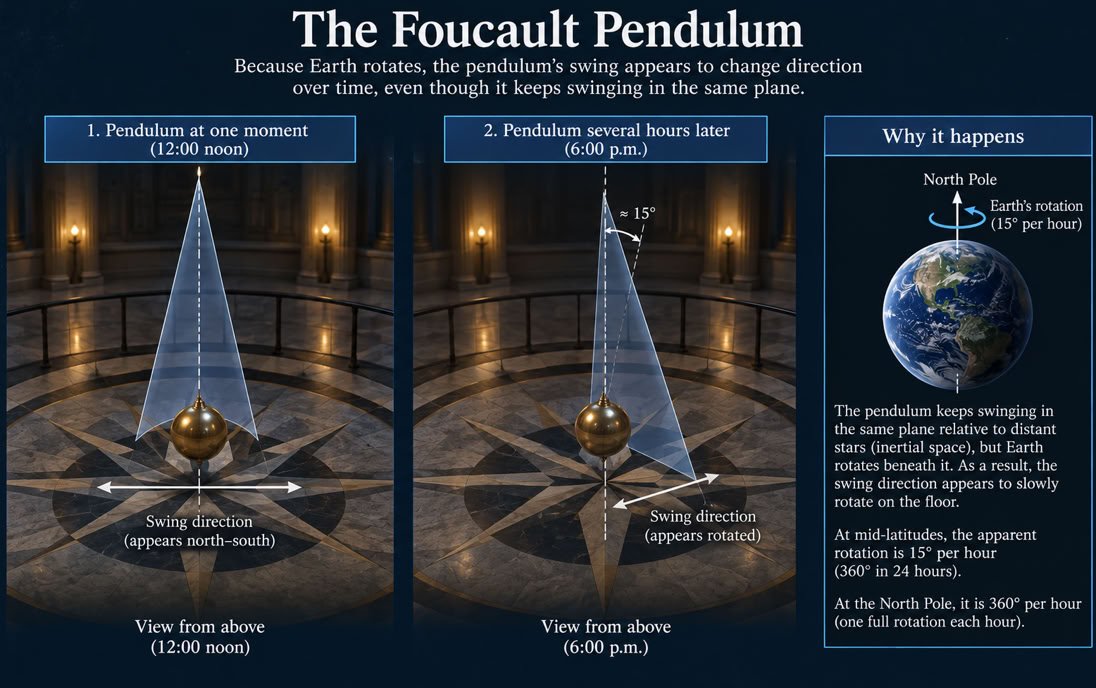
The successful measurements of stellar aberration and stellar parallax conclusively proved that Earth moves through space and that it orbits the Sun. In 1851 Léon Foucault demonstrated that Earth also rotates on its axis. He did that by hanging a heavy pendulum from a long wire and making it swing back and forth. His public demonstration at the Panthéon in Paris used a wire about 220 feet long and a 62-pound weight.
Once the a pendulum was swinging freely, its plane of oscillation would remain fixed in space. But the floor under the pendulum was rotating along with Earth. Foucault arranged a series of marks on the floor. As time passed, the pendulum's path shifted relative to those marks, demonstrating that the floor was moving relative to the fixed pendulum.
This was the first simple, direct demonstration that Earth rotates. And its effect was predictably variable based on the latitude at which the experiment was performed. As expected, the pendulum doesn’t rotate at all at the equator, and its rotation increases as it moves away from the equator. At the pole the effect is most pronounced, and the pendulum rotates 360 degrees in 24 hours.
The Rotating Earth Makes Geostationary Satellites Possible
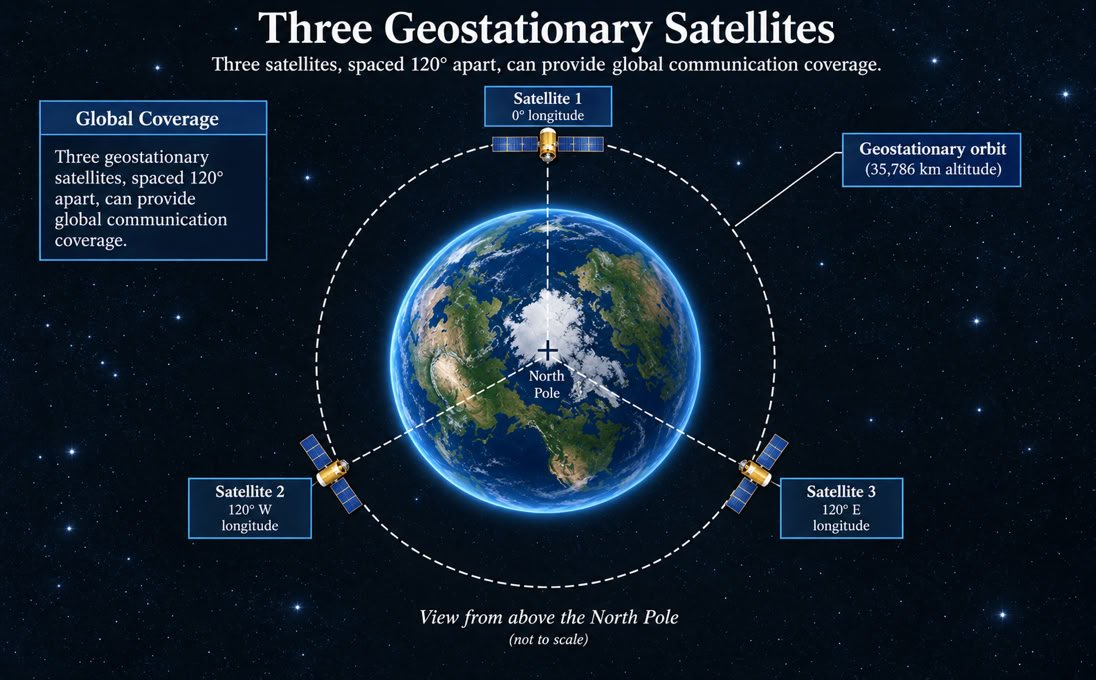
It wasn’t long before people began to contemplate the practical applications of a rotating Earth. In his 1929 book The Problem of Space Travel, Herman Potočnik (writing under the pseudonym Hermann Noordung) calculated that a manned space station placed approximately 35,900 km (22,300 miles) above Earth's surface over the equator would orbit Earth once in roughly the same time it takes Earth to rotate once. Therefore, the station would remain approximately over the same point on Earth's surface at all times. This type of orbit is called “geostationary.” Potočnik thought that because such a station would continuously observe the same large area of Earth's surface, it would be useful for geographical, scientific, and practical observations.
In October 1945, British science-fiction writer Arthur C. Clarke published an article titled "Extra-Terrestrial Relays" in the British electronics magazine Wireless World. Clark envisioned a network of three unmanned communication satellites placed in geostationary orbit and equidistantly spaced around the world. In such a network, each satellite would always be able to “see” the other two, and so television and radio could be broadcast all over the inhabited world.
Clarke’s vision was realized in 1965 with the launch of Intelsat 1. To this day the geostationary orbital band is called the “Clarke Belt” in his honor.
Conclusion
Our understanding of the universe began with the reasonable assumption that our senses were giving us an accurate perception of it. It appeared that the solid Earth under our feet did not move, and the objects we saw in the sky did. But there were things that were difficult to explain, like the retrograde motion of the planets. And just because Earth felt like it wasn’t moving didn’t mean it wasn’t. Our bodies can sense acceleration, but not steady motion. If you close your eyes when you’re in an airliner that’s not accelerating, you can’t tell you’re moving.
Nicholas Copernicus realized that if Earth were orbiting the Sun instead of the other way around, then everything made sense. The planets, including Earth, were all moving in circles around the sun. What we saw as retrograde motion was merely earth passing the outer planets and being passed by the inner planets as they all orbited the Sun.
Then Isaac Newton discovered the law of universal gravitation that explained how things move in the universe, both on Earth and in space. And he proved that only the massive Sun could be the object around which all the planets, including Earth, orbited.
Forty years later, James Bradley proved that Earth was moving through space, and 110 years after that, Friedrich Bessel proved that Earth was orbiting the Sun.
Finally, in 1851 Léon Foucault proved with his clever pendulum demonstration that Earth also rotates on its axis, a fact that scientists and engineers took advantage of to place roughly 2,000 satellites into geostationary orbit since the 1960s.
That’s how we came to know, and to prove, that Earth moves through space, that it orbits the Sun, and that it rotates on its axis.
__________
1 Galileo Galilei, Dialogue Concerning the Two Chief World Systems, Fourth Day (1632), trans. Stillman Drake.
2 A Fraunhofer heliometer was a 19th-century refracting telescope with a split objective lens, designed by German physicist and optician Joseph von Fraunhofer to measure tiny angular distances between stars with extreme precision.
Archive
Recent Additions

Copyright © 2024-2026 Catholicoutlook.me