Common Objections
Common Objections
Catholic Outlook
Catholic Outlook

Catholic Outlook
Common Objections
Common Objections
__________ Recent Additions __________
Catholic Outlook
Catholic Outlook
__________ Catholic Customs __________
“Catholics Worship Statues.”
Gary Hoge
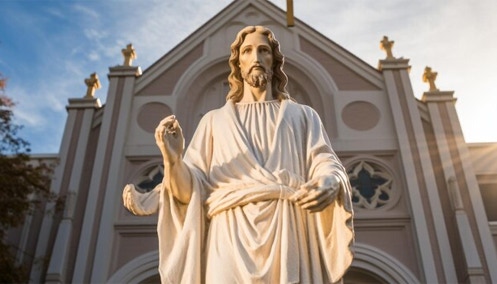
One of the first things you might notice upon entering a Catholic Church is the statues – statues of Jesus, statues of Mary, statues of various saints. If you are from a church that is spare in its use of religious imagery, these statues might make you feel uncomfortable. You may even accuse the Catholic Church of idolatry and disobedience. After all, doesn’t the Bible forbid the use of any and all images?
Well, let’s look at exactly what the Bible says:
Thou shalt not make unto thee any graven image, or any likeness of any thing that is in heaven above, or that is in the earth beneath, or that is in the water under the earth. Thou shalt not bow down thyself to them, nor serve them. (Exodus 20:4-5, KJV).
If we interpret these verses literally, then even the simple wooden crosses that adorn many Fundamentalist Protestant churches would be forbidden. Indeed, any sculpture whatsoever, no matter how secular, would be forbidden. No birds, no fish, no nothing. Michelangelo’s “David” would be as much an abomination as the golden calf (Exodus 32:4). In fact, if you’re an American, and if you have a quarter in your pocket, you may well be violating the literal sense of these verses right now. If you take out that quarter and look at the back of it, you’ll see embossed thereon a graven image of an eagle, ancient symbol of the pagan God Jupiter!
Fortunately, the Bible itself does not support such a strict, hyper-literalistic interpretation. There are, after all, innocuous uses of sculpture found in the pages of the Old Testament. For example, King Solomon’s throne had armrests on both sides of the seat “with a lion standing beside each of them” (2 Chronicles 9:18) and twelve lions on the six steps in front of the throne (2 Chronicles 9:19). Of course, most Protestants would agree that God did not intend to forbid the making of any and every sculpture. The Protestant International Standard Bible Encyclopedia says,
An idol is usually considered as either the deity itself or his permanent tenement . . . The Second Commandment was not an attack upon artists and sculptors but upon idolaters. Decoration by means of graven figures was not anciently condemned.1
Although Protestants are generally not as enthusiastic in their use of religious imagery as are Catholics, most of them do indeed use “graven images” in their worship, even if it’s just a wooden cross or a dove representing the Holy Spirit. However, there are some who believe that the whole purpose of Exodus 20:4-5 was to forbid the creation of any sculpture intended for religious purposes, and that the use of any images whatsoever in worship constitutes idolatry. However, this interpretation does not hold up to scriptural scrutiny, because there are several occasions in the Bible in which God Himself commands the creation of sculptures for a religious purpose. For example, when God told Moses how to build the Ark of the Covenant, He said,
Make two cherubim out of hammered gold at the ends of the cover. Make one cherub on one end and the second cherub on the other; make the cherubim of one piece with the cover, at the two ends. The cherubim are to have their wings spread upward, overshadowing the cover with them. The cherubim are to face each other, looking toward the cover. (Exodus 25:18-20).
Likewise, the lamp-stands that Moses was commanded to make included sculptures of buds and blossoms (Exodus 25:31-36), and many years later the Sea that was made for the temple “stood on twelve bulls, three facing north, three facing west, three facing south, and three facing east. The Sea rested on top of them, and their hindquarters were toward the center” (2 Chronicles 4:4). Finally, in Numbers 21:8-9, we read,
The LORD said to Moses, “Make a snake and put it up on a pole; anyone who is bitten can look at it and live.” So Moses made a bronze snake and put it up on a pole. Then when anyone was bitten by a snake and looked at the bronze snake, he lived.
This bronze snake was created at the express command of God, and it served an explicitly religious, even sacramental function. However, many years later, something terrible happened: the Israelites began to worship the snake as an idol. Therefore, King Hezekiah destroyed it, as we read in 2 Kings 18:4:
[King Hezekiah] broke into pieces the bronze snake Moses had made, for up to that time the Israelites had been burning incense to it. (It was called Nehushtan.)
This incident clearly demonstrates God’s attitude toward the use of images: it’s okay to make sculptures for secular use, and it’s even okay to make sculptures for religious use, but it’s not okay to worship anything other than God.
The early Christians understood the difference between the use of images on the one hand, and the worship of images (idolatry) on the other. According to the 1917 edition of the Catholic Encyclopedia,
That Christians from the very beginning adorned their catacombs with paintings of Christ, of the saints, of scenes from the Bible and allegorical groups is too obvious and too well known for it to be necessary to insist upon the fact. … That the first Christians had any sort of prejudice against images, pictures, or statues is a myth (defended amongst others by Erasmus) that has been abundantly dispelled by all students of Christian archaeology. … Eusebius describes very ancient statues at Caesarea Philippi representing Christ and the woman He healed there (“Hist. eccl.”, VII, xviii, Matt., ix, 20-2). … The first Christians were accustomed to see statues of emperors, of pagan gods and heroes, as well as pagan wall-paintings. So they made paintings of their religion, and, as soon as they could afford them, statues of their Lord and of their heroes, without the remotest fear or suspicion of idolatry. The idea that the Church of the first centuries was in any way prejudiced against pictures and statues is the most impossible fiction.2
But what about the honor that Catholics show to images, isn’t that a form of worship? Well, no. There is a difference between “honor” and “worship.” The Protestant International Standard Bible Encyclopedia points out that “relics and symbolic figures do not become ‘images’ in the objectionable sense until reverence changes to worship.”3 Catholics agree with this. There is a big difference between showing proper reverence to a religious image, and worshipping that image. God expects people to have a proper respect for religious images. In the Old Testament, He actually killed anyone who treated the Ark of the Covenant disrespectfully!
Perhaps it would help to point out that a Catholic’s veneration of a statue of Jesus is analogous to a patriotic American’s veneration of the American flag. We honor (show respect to) the flag, not because of what it is (a piece of cloth), but because of what it represents (America). Likewise, Catholics honor (show respect to) a statue of Jesus, not because of what it is (plaster and paint), but because of who it represents (Jesus). When we face the American flag, put our hand over our heart, and pledge our allegiance to that flag, we’re really pledging our allegiance to America, which the flag represents. In the same way, when a Catholic reverences a statue of Jesus, he is really reverencing Jesus, whom the statue represents. Catholics do not believe that the statue is Jesus, or that he lives within it, and they certainly don’t worship it.
But don’t Catholics pray to statues? No, not at all. They may pray toward a statue, but that’s a very different thing. Protestants do this too. For example, in church they may pray facing the pulpit or a cross on the wall, or they may lift their hands and their eyes up to heaven (as if God were located more “up” than “down”). Obviously, these Protestants are not praying to the pulpit, or to the cross, or to the sky. Likewise, Catholics who pray facing a statue of Jesus are not praying to the statue, but to Jesus. The statue merely serves to focus our attention on the one to whom we are praying, in much the same way that a man writing a letter to his girlfriend might keep a picture of her in front of him as he writes, to focus his attention on the one to whom he is writing.
__________
1 Camden M. Cobern, “Images,” International Standard Bible Encyclopedia, ed. James Orr, 1915.
2 Catholic Encyclopedia, “Veneration of Images,” 1917.
3 Cobern, “Images.”
Copyright © 2024 Catholicoutlook.me
MENU