Common Objections
Common Objections
Catholic Outlook
Catholic Outlook

Catholic Outlook
Common Objections
Common Objections
__________ Recent Additions __________
Catholic Outlook
Catholic Outlook
__________ Catholic Customs __________
“Catholics are being disobedient when they call their priests ‘father,’ because the Bible plainly says, ‘Call no man on earth father.”
Gary Hoge
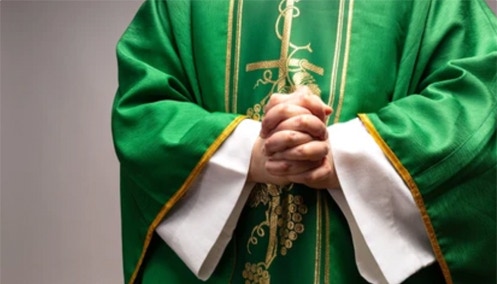
Calling priests “father” is not a uniquely Catholic practice. The Eastern Orthodox also call their priests “father,” as do even some Protestants (e.g., the Anglicans). But some other Protestants believe that this practice clearly contradicts what Jesus said in Matthew 23:9:
And do not call anyone on earth “father,” for you have one Father, and he is in heaven.
That seems clear enough, doesn’t it? Catholics (and Orthodox, and Anglicans, etc.) are doing something that Jesus appears to have specifically forbidden. Therefore, they must be either biblically illiterate or disobedient. At least, that’s how it appears at first glance. But let’s look a little closer. Ironically, most people who make this objection never seem to consider the very next verse:
Nor are you to be called ‘teacher,’ for you have one Teacher, the Christ (Matt. 23:10).
I’ve never met a Christian who objected to a teacher being called “teacher,” yet Jesus appears to have forbidden the use of that title just as clearly as he apparently forbade the use of the title “father.” It seems strange for some Christians to criticize the Catholic Church (and others) for violating the literal sense of verse 9 when they themselves have no qualms about violating the literal sense of verse 10. So perhaps there’s more to this than meets the eye.
To understand what’s really happening here, let’s look at verse 9 in detail. What is Jesus saying here? If we interpret the phrase “do not call anyone on earth ‘father’” too literally, it would mean that we couldn’t even refer to our male biological parent as “father.” Obviously, that’s not what Jesus had in mind, and no one interprets this verse in such a narrow fashion. By all accounts the proper interpretation must be somewhat less than strictly literal, because for each of us there is at least one man on earth whom we may address as “father.”
The common understanding, among those who are critical of the practice of calling priests “father,” is that Jesus meant to forbid the use of this word as a religious title, the very thing Catholics do! But if we let Scripture interpret Scripture, this argument falls apart. For one thing, the apostles themselves referred to their followers as their spiritual children, and to themselves as spiritual fathers. For example, Paul wrote,
Even though you have ten thousand guardians in Christ, you do not have many fathers, for in Christ Jesus I became your father through the gospel (1 Corinthians 4:15).
Was Paul being disobedient by referring to himself as the spiritual father of the Corinthians? If he was not, then neither are Catholics. But there’s more: Consider Paul’s comment to the Philippians about Timothy:
But you know that Timothy has proved himself, because as a son with his father he has served with me in the work of the gospel. (Philippians 2:22).
Writing to Timothy directly, Paul referred to him as “my son” (1 Timothy 1:18, 2 Timothy 2:1) and “my beloved son” (2 Timothy 1:2). Likewise, he also addressed Titus as “my true son” (Titus 1:4). To Philemon, he wrote,
I appeal to you for my child, whom I have begotten in my imprisonment, Onesimus. (Philemon 1:10).
Paul also referred to Abraham as the “father of all who believe” (Romans 4:11), specifically including the Gentiles, who are not biologically descended from Abraham. So Abraham is the spiritual father of believing Gentiles, according to Paul.
Looking further in the New Testament, we find that the first Christian martyr, Stephen, addressed the Jewish high priest and the Sanhedrin as “brothers and fathers” (Acts 7:2). Also, the apostle John, the disciple whom Jesus loved, routinely referred to his followers as “my little children” (e.g., 1 John 2:1, 2:12, 2:28, 3:7, 3:18, etc.) Lastly, Jesus himself referred to Abraham in a parable twice as “Father Abraham” (Luke 16:24, 16:30). So it would seem that either Paul, Stephen, John, and even Jesus Himself, misunderstood Jesus’s command, or some modern Christians have.
But if Jesus didn’t mean to forbid the use of the word “father” in a biological context, or in a spiritual context, what did He mean? What’s left? Well, the key to understanding this verse is to understand that the ancient, Eastern people to whom Jesus spoke these words often used hyperbolic, exaggerated statements that are not meant to be taken literally. According to Protestant author John W. Haley,
The people of the East are fervid and impassioned in their modes of thought and expression. They think and speak in poetry. Bold metaphors and startling hyperboles abound in their writings and conversation... He who does not remember the wide difference between the Oriental and Occidental mind, must necessarily fall into error.1
Examples of this vivid hyperbole abound in the New Testament (see, e.g., Matthew 5:29-30, Matthew 17:20, Luke 14:26, etc.) We Americans tend to forget this. We approach the New Testament as if it were originally written in English and its authors were contemporary Americans. We expect them to write as we would write, and thus we tend to read the Bible as if it were a contract drawn up by lawyers. Too often we mistake the Eastern poet for a Western essayist, and when we run across examples of the vivid exaggeration that was typical of ancient semitic writing, we don’t know what to make of it. And so we fret about whether we are allowed to call someone “father” (a practice to which the apostles had no objection), when in reality Jesus was simply expressing, in typically flamboyant Eastern style, the idea that no man is to take the place of God in our lives. The Protestant International Standard Bible Encyclopedia acknowledges that this is the true meaning of the text:
Christ’s condemnation is clearly of the praise-seeking or obsequious spirit, rather than of a particular custom.2
This verse isn’t about the proper use of the word “father,” it’s about the proper attitude of Christians toward their brothers, and toward God. Therefore, it’s perfectly appropriate for Catholics, and others, to give the title “father” to their ministers. In doing so they are not being disobedient to Jesus, rather they are following the apostolic example established by Paul and John.
__________
1 John W. Haley, Alleged Discrepancies of the Bible, (Springdale, PA: Whitaker House, 14.
2 Philip Wendell Crannell, “Father,” International Standard Bible Encyclopedia, ed. James Orr, 1915.
Copyright © 2024 Catholicoutlook.me
MENU