

Common Objections
Common Objections
Catholic Outlook
Catholic Outlook

Catholic Outlook
Common Objections
Common Objections
__________ Recent Additions __________
Catholic Outlook
Catholic Outlook
__________ Moral Teachings __________
“Catholics are wrong to object to the practice of contraception. Contraception is simply good stewardship.”
Gary Hoge
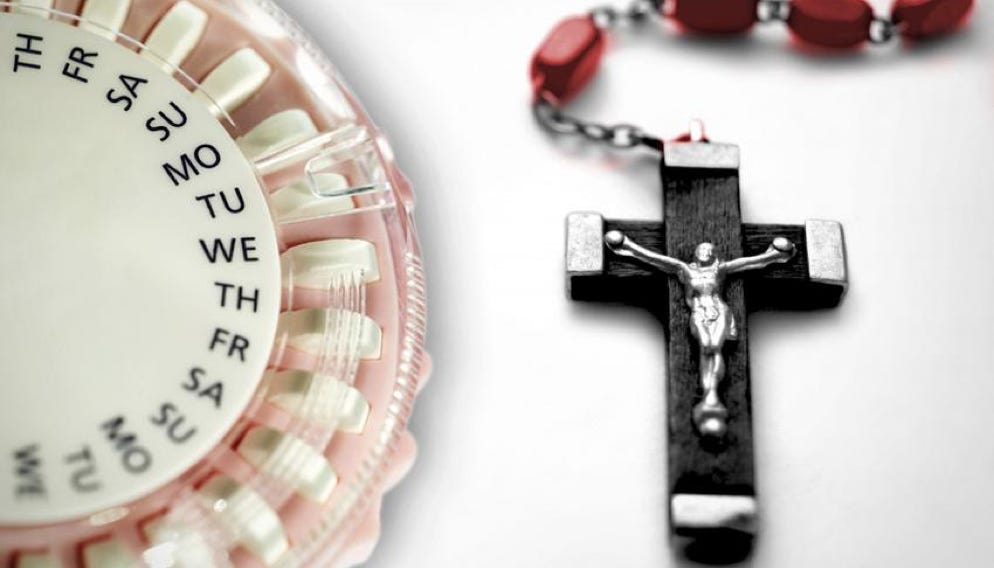
I used to feel the same way. When my future wife and I were receiving pre-marital counseling from our Evangelical pastor, it was never a question of whether we would use contraception, but only what type we would use. This attitude is typical of the average Protestant denomination today, and so I was surprised to discover that every single Protestant denomination in the world had condemned contraception as a grave sin until 1930! Believe it or not, that is true. Listen to the words of Protestant author Charles Provan:
We will go one better, and state that we have not found one orthodox theologian to defend Birth Control before the 1900’s. Not one! On the other hand, we have found that many highly regarded Protestant theologians were enthusiastically opposed to it, all the way back to the very beginning of the Reformation.1
In the year 1930, the Anglicans, meeting at their Lambeth conference, decided to allow contraception in certain “hard-luck” cases. But once the floodgates were opened, denomination after denomination caved to social pressure and decided that contraception was no longer sinful. Eventually, it came to be seen by some as a praiseworthy act of stewardship. The founders of Protestantism must be rolling in their graves. Their belief was that contraception was a grave sin, in the same league as adultery and murder. For example, Martin Luther wrote,
[T]he exceedingly foul deed of Onan, the basest of wretches . . . is a most disgraceful sin. It is far more atrocious than incest and adultery. We call it unchastity, yes, a sodomitic sin. For Onan goes in to her; that is, he lies with her and copulates, and when it comes to the point of insemination, spills the semen, lest the woman conceive. Surely at such a time the order of nature established by God in procreation should be followed. Accordingly, it was a most disgraceful crime . . . Consequently, he deserved to be killed by God. He committed an evil deed. Therefore, God punished him.2
Likewise, John Calvin wrote,
The voluntary spilling of semen outside of intercourse between man and woman is a monstrous thing. Deliberately to withdraw from coitus in order that semen may fall on the ground is doubly monstrous. For this is to extinguish the hope of the race and to kill before he is born the hoped-for offspring. This impiety is especially condemned, now by the Spirit through Moses’ mouth, that Onan, as it where, by a violent abortion, no less cruelly than filthily cast upon the ground the offspring of his brother, torn from the maternal womb. Besides, in this way he tried, as far as he was able, to wipe out part of the human race.3
Sixteenth-century Lutheran theologian Lukas Osiander wrote,
[Onan’s contraceptive act] was an abhorrent thing and worse than adultery. Such an evil deed strives against nature, and those who do it will not possess the kingdom of God (1 Cor. 6:9-10). The holier marriage is, the less will those remain unpunished who live in it in a wicked unfitting way so that, in addition to it, they practice their private acts of villainy.4
The seventeeth-century Synod of Dort, a Calvinist council, declared,
[Onan’s contraceptive act] was even as much as if he had, in a manner, pulled forth fruit out of the mother’s womb and destroyed it.5
John Wesley, the founder of the Methodist Church, wrote,
Those sins that dishonor the body are very displeasing to God, and the evidence of vile affections. Observe, the thing which he [Onan] did displeased the Lord—And it is to be feared; thousands, especially of single persons, by this very thing, still displease the Lord, and destroy their own souls.6
The early Christians were also unanimous in their rejection of artificial birth control. I could cite many examples, but St. Augustine summarizes their thinking quite clearly:
I am supposing, then, although you are not lying [with your wife] for the sake of procreating offspring, you are not for the sake of lust obstructing their procreation by an evil prayer or an evil deed. Those who do this, although they are called husband and wife, are not; nor do they retain any reality of marriage, but with a respectable name cover a shame. Sometimes this lustful cruelty, or cruel lust, comes to this, that they even procure poisons of sterility [oral contraceptives] . . . Assuredly if both husband and wife are like this, they are not married, and if they were like this from the beginning they come together not joined in matrimony but in seduction. If both are not like this, I dare to say that either the wife is in a fashion the harlot of her husband or he is an adulterer with his own wife.7
Fortunately, there are many Protestants, like Nate Wilson, who are rediscovering their theological roots, and who are once again aligning themselves with the voices of the Reformers, and of all of historic Christianity, in rejecting contraception:
Christians have also historically not practiced birth control. This is not a Roman Catholic church issue—their practice is a carry-over from a time when all Christians did not practice birth control. The Protestant Synod of Dort equated contraception with abortion. Martin Luther, John Calvin, John Wesley, and many other founders of Protestantism linked birth control with murder. The Pilgrims who founded our country considered birth control as bad as adultery and disqualified anyone from church leadership who practiced it.8
It is important to note that Christians prior to the 20th century unanimously rejected contraception as gravely sinful, because, as Evangelical scholar Timothy George noted,
The massive consensus of thoughtful Christian interpretation of the Word down the ages (and on most matters of importance there is such a thing) is not likely to be wrong.9
__________
1 Charles Provan, The Bible and Birth Control, (Monongahela, PA: Zimmer Printing, 1989), 63.
2 Martin Luther, Commentary on Genesis.
3 Calvin’s Latin Commentary on Genesis 38:10.
4 Lukas Osiander, Commentary on Genesis.
5 Dutch Annotations on the Whole Bible, authorized by Dort.
6 John Wesley, Commentary on Genesis.
7 Augustine, Marriage and Concupiscence 1:15:17, A.D. 419.
8 Nate Wilson, The Case Against Birth Control, see http://home.att.net/~nathan.wilson/brthcntl.htm.
9 Timothy George, “What We Mean When We Say It’s True,” Christianity Today, Oct 23, 1995, 19.
Copyright © 2024 Catholicoutlook.me
MENU