Common Objections
Common Objections
Catholic Outlook
Catholic Outlook

Catholic Outlook
Common Objections
Common Objections
__________ Recent Additions __________
Catholic Outlook
Catholic Outlook
__________ The Pope __________
“Paul taught that it was wrong to follow Peter (supposedly the first pope) instead of Christ (1 Cor. 1:12-13; 3:22).”
Gary Hoge
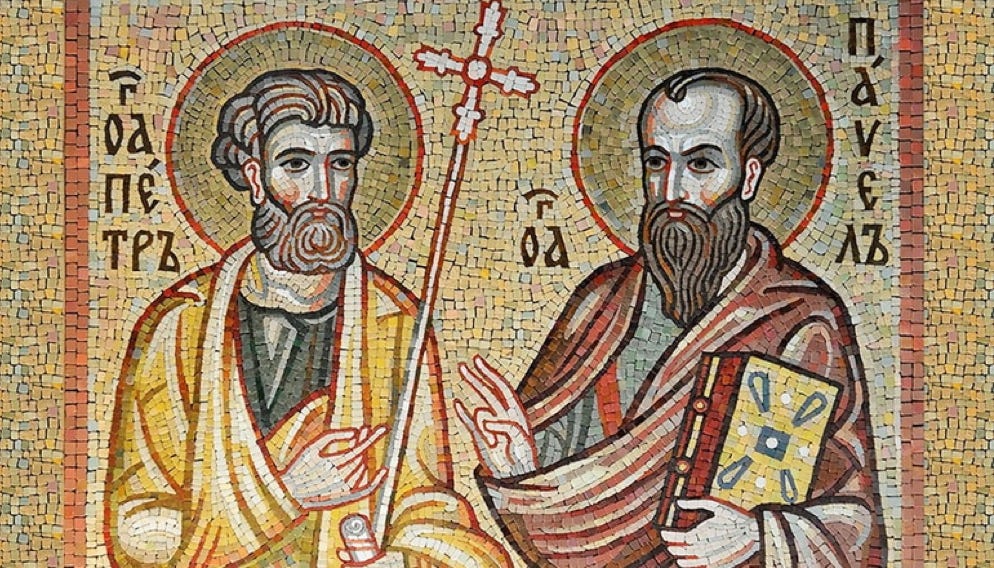
It is wrong to follow Peter (or anyone else) instead of Christ, but one way we follow Christ is by following the leaders he appointed in the Church. He himself said,
“He who listens to you listens to me; he who rejects you rejects me; but he who rejects me rejects him who sent me” (Luke 10:16)
And Hebrews 13:17 says,
Obey your leaders and submit to their authority. They keep watch over you as men who must give an account. Obey them so that their work will be a joy, not a burden, for that would be of no advantage to you.
What Paul was arguing against in 1 Corinthians was the all-too-human tendency of dividing into factions. He wrote,
My brothers, some from Chloe’s household have informed me that there are quarrels among you. What I mean is this: One of you says, “I follow Paul”; another, “I follow Apollos”; another, “I follow Cephas’”; still another, “I follow Christ.”
This is a tendency that unfortunately continues to this day. One of you says, “I follow Luther,” and another, “I follow Calvin.” And on the Catholic side, “I follow Cardinal So-and-So,” or “I follow this celebrity priest.”
We’re supposed to follow our leaders, but not elevate them to the point that we fracture the unity of the Church. Paul was admonishing the Corinthians to maintain unity. He said, “I appeal to you, brothers, in the name of our Lord Jesus Christ, that all of you agree with one another so that there may be no divisions among you and that you may be perfectly united in mind and thought.” (1 Corinthians 1:10).
Paul was an authoritative leader in the Church, and he expected to be obeyed. He wrote, “For even if I boast somewhat freely about the authority the Lord gave us for building you up rather than pulling you down, I will not be ashamed of it” (2 Corinthians 10:8). However, he did not want his people to make him the center of their religion. He did not want them to lose sight of the fact that he was just a servant of God. And that goes for the other apostles, too, including Peter.
In the apostolic Church, Peter was chief among the apostles, as Protestant scholar W.F. Albright acknowledges:
Peter as Rock will be the foundation of the future community... To deny the pre-eminent position of Peter among the disciples or in the early Christian community is a denial of the evidence. The interest in Peter’s failures and vacillations does not detract from this pre-eminence; rather, it emphasizes it. Had Peter been a lesser figure his behavior would have been of far less consequence.1
The pope is chief among the bishops because he is the successor of Peter, who was chief among the apostles, but the pope was not crucified for us, and no one is baptized into the name of the pope. Jesus Christ is the center of our faith. The pope, though he is an authoritative leader, is merely a fellow servant. In fact, one of his titles is the Latin phrase servus servorum Dei, “servant of the servants of God.”
__________
1 W.F. Albright and C. S. Mann, Matthew (Garden City, NY: Doubleday & Co., 1971), 195.
Copyright © 2024 Catholicoutlook.me
MENU