The Church
The Church
The Church
The Church
The Church
The Church
The Church

Catholic Outlook

Did Peter Ever Go to Rome?
Did Peter live and die in Rome? Does it matter?
In a publication by the Church of God, a Pentecostal Holiness denomination, Peter Nathan wrote,
Like many popes before him, Benedict XVI has sought to reaffirm the Roman Catholic Church’s authority as compared with that of the Protestant churches, which he sees as lacking apostolic credentials. The pope bases his case on the long-held belief that the apostle Peter founded the church in Rome.1
That's a mischaracterization of the Catholic position. We don't hold that the bishop of Rome is the head of the Church simply because Peter founded the Church there, but because the bishop of Rome is the successor of Peter. After all, Jesus didn't say, "On this rock I will build my church, but only if you establish it at Rome."
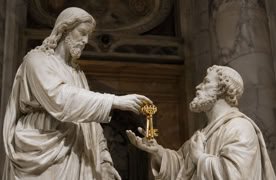
As I showed in my article I Tell You that You Are Peter, Jesus made Peter the earthly leader of his Church, and the Catholic Church holds that this leadership continued through his successors. According to early Christian accounts, Peter ministered in Rome toward the end of his life, where he was martyred, and the bishops of Rome inherited his office.
But the location of the papacy isn't essential to its authority. The pope doesn't have to live in Rome. In fact, seven consecutive popes resided in Avignon, France, for nearly seventy years during the fourteenth century.
So even if Peter had never set foot in Rome, that wouldn't by itself disprove the Catholic doctrine of papal succession. Nevertheless, whether he actually went there is an interesting historical question. And as we'll see, the evidence that he did is substantial.
The biblical evidence
The Bible tells us surprisingly little about where the apostles went after the ascension of Jesus. We know that Peter preached in Jerusalem, traveled to Samaria, visited Cornelius in Caesarea, and was present at the Council of Jerusalem. But Acts shifts its attention primarily to Paul, leaving much of Peter's later ministry unrecorded.
There is, however, an intriguing clue at the end of Peter's first epistle:
She who is in Babylon, chosen together with you, sends you her greetings, and so does my son Mark. (1 Peter 5:13)
What did Peter mean by "Babylon"?
There was, of course, an actual city of Babylon in Mesopotamia, in what is now Iraq. But according to Baptist Bible commentator Grant Richison, “‘Babylon,’ the literal city, was almost nonexistent in Peter's time.”2 Nevertheless, the once-powerful Babylon could still serve as a symbol of an empire that oppressed God's people.
The original Babylonian Empire had conquered Jerusalem, destroyed the Temple, and carried the Jews into exile. Centuries later, Rome ruled over the Jewish people and eventually destroyed Jerusalem and its Temple in AD 70. The resemblance made Babylon a natural symbol for Rome.
The book of Revelation uses Babylon in this way. In chapters 17 and 18, Babylon is portrayed as a great city exercising dominion over the nations. Its association with seven hills (Revelation 17:9) strongly suggests Rome, which was famously built on seven hills.
Consequently, many biblical scholars understand Peter's reference to Babylon as a reference to Rome.
This interpretation also fits the mention of Mark. Paul refers to Mark in letters commonly associated with his Roman imprisonment (Colossians 4:10; Philemon 24). If Peter was writing from Rome, the presence of Mark would hardly be surprising.
Of course, the reference to Babylon isn't conclusive. Some commentators understand it literally, while others have proposed Jerusalem. But identifying Babylon with Rome makes sense and has considerable historical support.
And it isn't merely a Catholic interpretation. Alexander MacLaren, a Scottish Baptist minister, concluded that Babylon meant Rome.3 Baptist commentator Grant Richison likewise wrote that Peter was in Rome during his final years and suggested that Babylon might have been a code name for Rome.2 Possibly, Peter was trying to conceal his location in case his letter was intercepted..
But the biblical evidence is only part of the story.
The testimony of the early Church
The strongest evidence for Peter's presence in Rome comes from the early Christians themselves. Several ancient writers associate Peter with Rome, and their testimony predates both the medieval papacy and the Protestant Reformation by centuries.
Around AD 96, the Church in Rome sent a letter to the Christians in Corinth, commonly attributed to Clement of Rome. The letter refers to the sufferings and deaths of Peter and Paul, presenting them as examples of perseverance under persecution.4
Clement doesn't explicitly say that Peter died in Rome. Nevertheless, his testimony is significant because it comes from the Roman Church itself, only a few decades after the apostles' deaths. He treats their martyrdoms as events already familiar to his readers.
A few years later, around AD 110, Ignatius of Antioch wrote to the Christians in Rome while traveling to his own martyrdom. In that letter, he distinguished himself from Peter and Paul, saying that he could not command the Roman Christians as those apostles had.5
Although Ignatius doesn't describe their ministry or deaths, his statement suggests that both apostles had exercised authority among the Christians in Rome.
By the latter part of the second century, the testimony becomes even more explicit.
Irenaeus, bishop of Lyons, wrote his Against Heresies around AD 180. In discussing how the apostles' teaching had been preserved through the succession of bishops, he identified the Church of Rome as one founded and organized by Peter and Paul. He then traced its succession of bishops, beginning with Linus.6
Elsewhere, Irenaeus stated that Peter and Paul had preached in Rome and laid the foundations of the Church there.7
This is especially important because Irenaeus wasn't simply repeating a belief that arose centuries after the apostles. He had known Polycarp, bishop of Smyrna, who in turn had known Christians of the apostolic generation. Irenaeus therefore stood relatively close to the events he was describing.
Around the same time, Dionysius, bishop of Corinth, associated Peter and Paul with ministry and martyrdom in Italy. His testimony is preserved by the fourth-century historian Eusebius.8
Another early witness was Gaius, a Roman Christian writing around AD 200. He referred to monuments commemorating Peter and Paul, identifying their locations as the Vatican and the Ostian Way.9 These were the locations associated with the apostles' burial places.
Notice that these witnesses came from different parts of the Christian world: Rome, Antioch, Gaul, and Corinth. The association of Peter with Rome wasn't merely a local Roman claim.
Writing in the early fourth century, Eusebius of Caesarea gathered much of the available historical information about the early Church.
In his Church History, he stated that Peter had preached in Rome and that Mark had preserved Peter's preaching in his Gospel. Eusebius also explained the reference to Babylon in Peter's first epistle:
And Peter makes mention of Mark in his first epistle which they say that he wrote in Rome itself, as is indicated by him, when he calls the city, by a figure, Babylon.10
Eusebius also reported that Peter and Paul suffered martyrdom in Rome during Nero's reign.11
Of course, Eusebius wrote more than two centuries after these events, so his testimony must be evaluated accordingly. But he drew upon earlier Christian writers, including sources whose works have otherwise been lost.
Taken together, these accounts show that the belief that Peter ministered and died in Rome was firmly established among early Christians.
The archaeological evidence
There is also physical evidence supporting the ancient belief that Peter was buried in Rome.
According to early Christian accounts, Peter was crucified during Nero's persecution of Christians, probably sometime in the 60s AD, and buried near the Vatican Hill.11
As we saw earlier, around AD 200 Gaius identified the Vatican as the location of a memorial associated with Peter. This places the belief that Peter was buried there more than a century before Christianity was legalized under Constantine.
When Constantine built the original St. Peter's Basilica in the fourth century, he placed it over a burial site already associated with the apostle. This presented considerable engineering difficulties because the builders had to level part of the Vatican hillside and construct the basilica over an existing cemetery.12
Why undertake such an enormous project at that particular location unless Christians already regarded it as Peter's burial place?
Modern archaeology has provided further evidence.
Excavations beneath St. Peter's Basilica, begun in 1939 under Pope Pius XII, uncovered an ancient Roman cemetery and a small second-century funerary monument beneath the high altar. Archaeologists identified the monument with the memorial described by Gaius.12
They also discovered early Christian graffiti associated with Peter and human bones that some investigators concluded could be his remains.13
In 1968, Pope Paul VI announced that the relics of St. Peter had been identified in a manner he considered convincing.14
However, the identification of the bones remains disputed. Archaeology cannot establish with certainty that they belonged to Peter. The evidence for an ancient memorial associated with Peter is stronger than the evidence identifying particular remains as his.
Nevertheless, the discoveries are important. They establish that Christians venerated a particular burial site on the Vatican Hill long before Constantine constructed his basilica.
The archaeological evidence therefore reinforces the historical testimony that Peter died and was buried in Rome.
What about the objections?
One objection is that the New Testament never explicitly says Peter went to Rome.
That's true. But the New Testament doesn't provide complete biographies of the apostles, and its silence about Peter's later movements is hardly surprising. Acts tells us very little about what happened to most of the Twelve after the Church's earliest years.
Another objection is that Paul doesn't mention Peter in his letter to the Romans. If Peter was the bishop of Rome, why didn't Paul acknowledge him?
But this assumes Peter was already in Rome when Paul wrote the letter, generally dated to the late 50s. Peter could have arrived later, and many historical reconstructions place his final Roman ministry in the 60s.
Furthermore, Paul's letter doesn't name every Christian leader in Rome. His failure to mention Peter is worth considering, but it cannot establish that Peter never visited the city.
A related objection is that Peter couldn't have founded the Roman Church because a Christian community already existed there before he arrived.
That may well be true, depending on what we mean by founded. Paul wrote to an established Christian community in Rome before he himself visited the city, and the origins of that community are not known with certainty.
But the early Christian writers who associated Peter and Paul with the founding of the Roman Church weren't necessarily claiming that the two apostles were its first evangelists. They could have been referring to the apostles' role in establishing, organizing, and strengthening the Church there.
In any case, the question isn't whether Peter was the first person to preach the Gospel in Rome. It's whether he eventually ministered there and died there.
And the evidence that he did is substantial.
Conclusion
No surviving first-century document gives us a detailed account of Peter's arrival in Rome, his ministry there, or the circumstances of his death. And we cannot prove beyond all possible doubt that the remains beneath St. Peter's Basilica are his.
But historical conclusions rarely depend on that degree of certainty.
We have a biblical passage that plausibly places Peter in Rome, early Christian testimony connecting him with the Roman Church, multiple ancient witnesses to his martyrdom there, and archaeological discoveries consistent with his burial on the Vatican Hill.
And although not all ancient writers say where Peter died, none of the surviving early Christian accounts places his death anywhere other than Rome. No other city claimed to be the site of his martyrdom.15
None of this evidence is conclusive by itself. But taken together, it makes a compelling historical case. As Anglican commentator Charles Ellicott wrote:
We never hear of St. Peter being in the East, and the thing in itself is improbable, whereas nothing but Protestant prejudice can stand against the historical evidence that St. Peter sojourned and died at Rome. Whatever theological consequences may flow from it, it is as certain that St. Peter was at Rome as that St. John was at Ephesus.16
The belief that Peter had lived and died in Rome wasn't a medieval invention devised to justify the authority of the papacy. It was already well established among Christians in the early centuries of the Church.
Does this prove the Catholic doctrine of the papacy? No. Peter's presence in Rome doesn't, by itself, establish the authority of his successors. But neither does the Catholic doctrine of the papacy depend on proving that Peter went to Rome. Those are separate questions.
The historical question is simply whether Peter lived and died in Rome. And the biblical, historical, and archaeological evidence strongly indicates that he did.
__________
1 Peter Nathan, “Was Peter Ever in Rome?,” Vision, Summer 2008. https://foundations.vision.org/was-peter-ever-rome-952
2 Grant Richison, “1 Peter 5:13,” Verse-by-Verse Commentary, March 5, 1998. https://versebyversecommentary.com/1998/03/05/1-peter-513/
3 Alexander MacLaren, Expositions of Holy Scripture, commentary on 1 Peter 5:13, “The Church in Babylon.” https://biblehub.com/commentaries/maclaren/1_peter/5.htm
4 Clement of Rome, First Epistle to the Corinthians 5. https://www.newadvent.org/fathers/1010.htm
5 Ignatius of Antioch, Epistle to the Romans 4. https://www.newadvent.org/fathers/0107.htm
6 Irenaeus, Against Heresies 3.3.2–3. https://www.newadvent.org/fathers/0103303.htm
7 Irenaeus, Against Heresies 3.1.1. https://www.newadvent.org/fathers/0103301.htm
8 Eusebius of Caesarea, Church History 2.25.8, quoting Dionysius of Corinth. https://www.newadvent.org/fathers/250102.htm
9 Eusebius, Church History 2.25.6–7, quoting Gaius of Rome. https://www.newadvent.org/fathers/250102.htm
10 Eusebius, Church History 2.14–15. https://www.newadvent.org/fathers/250102.htm
11 Eusebius, Church History 2.25.5. https://www.newadvent.org/fathers/250102.htm
12 St. Peter's Basilica, “The Necropolis” and “The Tomb of Saint Peter,” archaeological and historical accounts by Pietro Zander. https://www.basilicasanpietro.va/en/san-pietro/the-necropolis and https://www.basilicasanpietro.va/en/san-pietro/the-tomb-of-saint-peter
13 St. Peter's Basilica, “The Tomb of Saint Peter,” discussion of the funerary monument, inscriptions, and archaeological discoveries. https://www.basilicasanpietro.va/en/san-pietro/the-tomb-of-saint-peter
14 Pope Paul VI, General Audience, June 26, 1968, “The Authenticity of the Relics of St. Peter in the Glorious Vatican Trophy.” https://www.vatican.va/content/paul-vi/it/audiences/1968/documents/hf_p-vi_aud_19680626.html
15 Philip Schaff, ed., Nicene and Post-Nicene Fathers, Second Series, vol. 1, commentary on Eusebius, Church History 2.25, note 6 https://ccel.org/ccel/schaff/npnf201.iii.vii.xxvi.html?utm_source=chatgpt.com; Markus Bockmuehl, “Peter's Death in Rome? Back to Front and Upside Down,” Scottish Journal of Theology 60, no. 1 (2007): 1–23. https://www.cambridge.org/core/journals/scottish-journal-of-theology/article/abs/peters-death-in-rome-back-to-front-and-upside-down/28C2A7CE52BAD643A1D0F3656D57BF42?utm_source=chatgpt.com
16 Charles John Ellicott, ed., Ellicott's Commentary for English Readers, commentary on 1 Peter 5:13. https://biblehub.com/commentaries/ellicott/1_peter/5.htm
Copyright © 2024–[YEAR] Catholicoutlook.me