Mary and the Saints
Mary and the Saints
Mary and the Saints
Mary and the Saints
Mary and the Saints
Mary and the Saints
Mary and the Saints

Catholic Outlook

Catholic Outlook
Catholic Outlook
The Brothers of the Lord
Were the brothers of Jesus also children of Mary?
There are several passages in the Gospels that refer to “brothers” and “sisters” of Jesus:
While Jesus was still talking to the crowd, his mother and brothers stood outside, wanting to speak to him (Matthew 12:46; cf. Mark 3:31; Luke 8:19).
Isn’t this the carpenter’s son? Isn’t his mother’s name Mary, and aren’t his brothers James, Joseph, Simon and Jude? Aren’t all his sisters with us? (Matthew 13:55–56).
Jesus’ brothers said to him, “You ought to leave here and go to Judea, so that your disciples may see the miracles you do” (John 7:3).
Who were these “brothers” and “sisters” of Jesus?
The evidence that they were children of Mary
Most modern Protestants believe that the brothers of Jesus were children of Joseph and Mary. If this view is correct, they all had the same mother (Mary), but not the same father (because Jesus was not the biological child of Joseph). Therefore, they were half-brothers.
At first glance, this seems like the most straightforward interpretation of the verses quoted above. For us, the usual meaning of the word “brother” is a person who has at least one parent in common.
Also, Matthew 1:25 says, “But he did not consummate their marriage until she gave birth to a son,” which seems to imply that they did consummate their marriage after she gave birth to Jesus. If so, it wouldn't be surprising if they had more children. And Jesus was called Mary's “firstborn” (Luke 2:7), which might suggest that there was a second-born, a third-born, and so on.
So how can Catholics (and the Eastern Orthodox, and, ironically, several of the Protestant Reformers) maintain that Mary had no children after Jesus?
Why this argument isn't compelling
First, Matthew 1:25 (“But he did not consummate their marriage until she gave birth to a son”) doesn't necessarily imply that they did consummate their marriage after she gave birth to Jesus.
That's because the Greek word translated “until,” ἕως (heōs), doesn't necessarily establish a contrast between what happened before and what happened afterward. It tells us what was true up to a particular point, without necessarily telling us whether anything changed after that point.
A few examples from the Bible should illustrate this:
In each case, the statement tells us what was true up to a certain point without necessarily telling us what happened afterward.
Matthew's purpose was to establish that Jesus was conceived without Joseph's participation, not to tell us about Joseph and Mary's subsequent marital relations.
Commenting on this verse, John Calvin wrote:
There have been certain strange folk who have wished to suggest from this passage [Matt. 1:25] that the Virgin Mary had other children than the Son of God, and that Joseph had then dwelt with her later; but what folly this is! For the gospel writer did not wish to record what happened afterwards; he simply wished to make clear Joseph's obedience and to show also that Joseph had been well and truly assured that it was God who had sent His angel to Mary. He had therefore never dwelt with her nor had he shared her company.1
Jesus being called Mary's “firstborn” doesn't establish that she had other children, either.
In ancient Israel, firstborn was a legal and religious designation. According to Exodus 13:2, every male child who first opened his mother's womb was to be consecrated to the Lord. This requirement applied whether or not his mother subsequently had other children.
Consequently, an only son was also a firstborn son. Jesus could have been Mary's firstborn even if she never had another child.
The English Protestant Reformer Hugh Latimer made the same argument. Commenting on the designation “firstborn,” he explained that it meant the child who first opened his mother's womb, and then affirmed that Mary “had no more, neither before nor after.”2
Latimer was responding to people who argued that calling Jesus Mary's firstborn necessarily implied that she had other children.
So neither Matthew 1:25 nor Luke 2:7 establishes that Mary had additional children. But what about the passages that explicitly refer to Jesus' brothers and sisters?
What does “brother” mean?
Since we're asking whether Jesus had biological siblings, the fact that the Bible specifically mentions his “brothers” and “sisters” would seem to settle the matter.
But does it?
The Greek word translated “brother” is ἀδελφός (adelphos). Its most common meaning is a male sibling, but that isn't its only meaning.
In our culture, we sometimes call someone a “brother”—or “bro”—even though he isn't our biological sibling. But in the biblical world, particularly among Hebrew- and Aramaic-speaking Jews, this usage was much more common. Using the word “brother” for someone other than a biological sibling was an established part of ordinary family terminology.3 It could refer not only to a biological brother, but also to other relatives, including cousins, nephews, and more distant kinsmen.
This broader usage carried over into the Greek translation of the Old Testament, the Septuagint, which was the version from which the New Testament writers usually quoted.
There are a couple of especially interesting examples in the Old Testament.
Abraham and Lot were uncle and nephew. Genesis 11:27 identifies Lot as the son of Abraham's brother Haran. Yet when Abraham and Lot separated, Abraham said:
Let there be no strife between you and me, and between your herdsmen and my herdsmen, for we are brethren (Genesis 13:8, NKJV).
The Greek Septuagint uses the word adelphoi, the plural of adelphos, to describe their relationship.
Similarly, Laban called Jacob his “brother” in Genesis 29:15, even though Jacob was his nephew.
Commenting on the brothers of Jesus in Matthew 13:55, the eighteenth-century Baptist theologian John Gill observed that it was
usual with the Jews to call such, and even more distant relations, brethren.4
But Greek had a word specifically meaning “cousin,” ἀνεψιός (anepsios). Paul even used it in Colossians 4:10. So if the Gospel writers meant that James, Joseph, Simon, and Jude were Jesus' cousins, why didn't they use that word?
Probably because they were Jews writing in Greek, and that affected their word choices. Apparently their native languages didn't have a word for cousin, so the fact that Greek did have such a word doesn’t necessarily mean they would have used it. Their language reflected typical Jewish ways of speaking, as we also see in the Greek Septuagint, which followed the Jewish custom of calling relatives other than biological siblings “brothers.”
Thus, the fact that the Gospels call James, Joseph, Simon, and Jude the “brothers” of Jesus does not, by itself, establish that they were children of his mother.
They might have been his half-brothers. But they might also have been other close relatives.
To determine which interpretation is more likely, we need to look at the rest of the evidence.
“Mary the mother of James and Joseph”
Matthew tells us:
Many women were there, watching from a distance. They had followed Jesus from Galilee to care for his needs. Among them were Mary Magdalene, Mary the mother of James and Joseph, and the mother of Zebedee's sons (Matthew 27:55–56).
We know Mary Magdalene, but who is this other Mary? Obviously, Matthew thinks she’s best known to his readers as the mother of James and Joseph since that’s how he identifies her. That makes it very unlikely that he’s referring to the Virgin Mary, who is obviously best known as the mother of Jesus, a man who figures prominently in the crucifixion story.
Also, Matthew tells us that Mary the mother of James and Joseph was one of the women who had followed Jesus from Galilee and cared for his needs during his ministry. The Gospels never identify the Virgin Mary as one of these women. In fact, Matthew 12:46–47 describes Mary and Jesus' brothers arriving while he was speaking to a crowd. Someone even interrupted Jesus to tell him that his mother and brothers were outside, wanting to speak with him.
That request for an audience sounds more like it came from an unexpected visitor than from someone who was traveling with him.
So we have at least two good reasons to think that the Mary who was the mother of James and Joseph and who followed Jesus from Galilee was someone other than his mother.
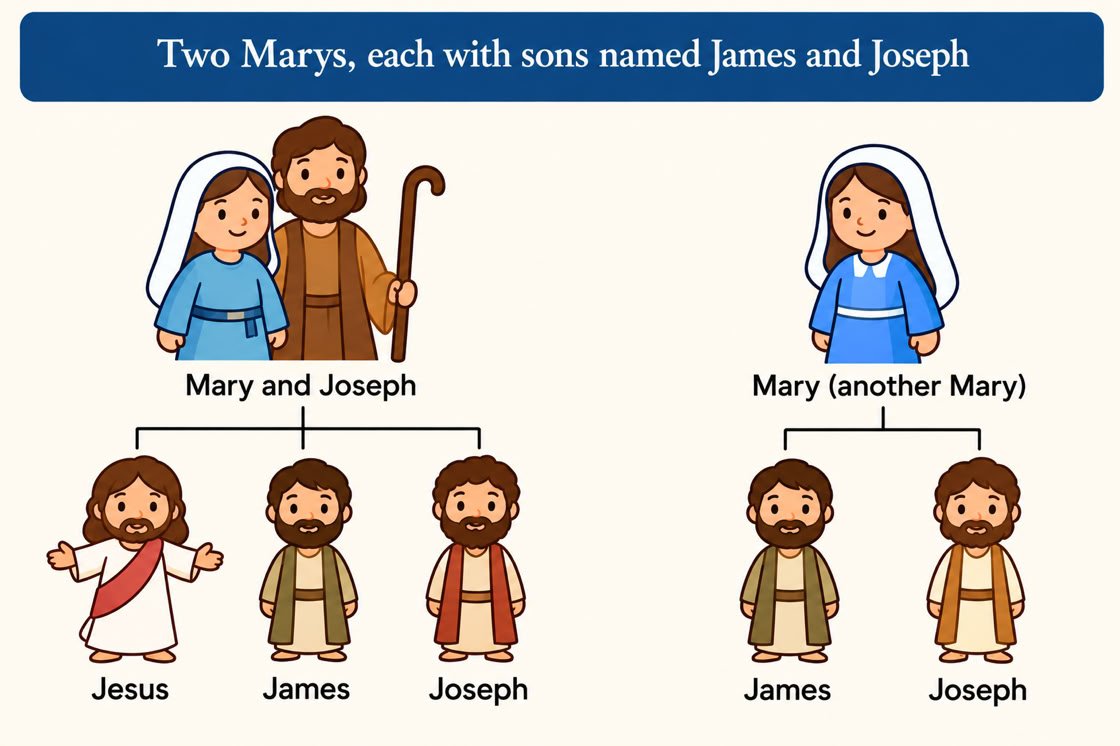
This is important because earlier Matthew told us that two of Jesus’ brothers were named James and Joseph (Matthew 13:55). If these are the same James and Joseph we’re talking about here, then at least two of Jesus’s “brothers” were not children of his mother, but of the other Mary, the one who had accompanied Jesus from Galilee.
If we still maintain that the brothers of Jesus were children of the Virgin Mary, then we have to suppose that there were two different Jameses and Josephs, one pair the children of the Virgin Mary and the other the children of the other Mary.
But that would mean that there were two women, both named Mary, both closely associated with Jesus, both witnessing his crucifixion, and both having sons named James and Joseph. That’s a lot of coincidences. And it would mean that Matthew referred to one of these women as “Mary the mother of James and Joseph” even though he knew that wouldn’t distinguish her from the other.
That seems unlikely. The most natural conclusion is that the woman Matthew identified as the mother of James and Joseph was not Jesus' mother. And since two of Jesus' brothers had those same names, they were probably the same men. In fact, their relation to Jesus as his brothers might help explain why their mother was at the crucifixion, and why she was one of the women who had followed Jesus from Galilee to care for his needs.
But why would the other Mary’s children be called brothers of Jesus when they weren’t, you know, brothers of Jesus?
That’s a good question, and it would be easier to answer it if we could figure out who the other Mary was. But that’s harder than you might think because the New Testament has more Marys than a Catholic girls’ school.
John’s account names several:
Near the cross of Jesus stood his mother, his mother's sister, Mary the wife of Clopas, and Mary Magdalene (John 19:25).
So we have at least three Marys at the cross, according to John. Matthew mentions another Mary, who may or may not be one of those three. So maybe four. And if the sister of the Virgin Mary was also named Mary—which at this point wouldn’t surprise us—we could have as many as five Marys at the crucifixion.
One of these Marys, according to Matthew, was the mother of James and Joseph. But which one?
I think we can rule out Mary Magdalene, and we've already seen why it's unlikely that Matthew was referring to the Virgin Mary. But what about Mary the wife of Clopas? She checks all the boxes, but why would her children be called brothers of Jesus?
John 19:25 gives us a possible clue.
The earliest Greek manuscripts of the New Testament were generally written without spaces between words and without the punctuation we're accustomed to today. Modern editors therefore have to decide where to place commas and other punctuation marks.
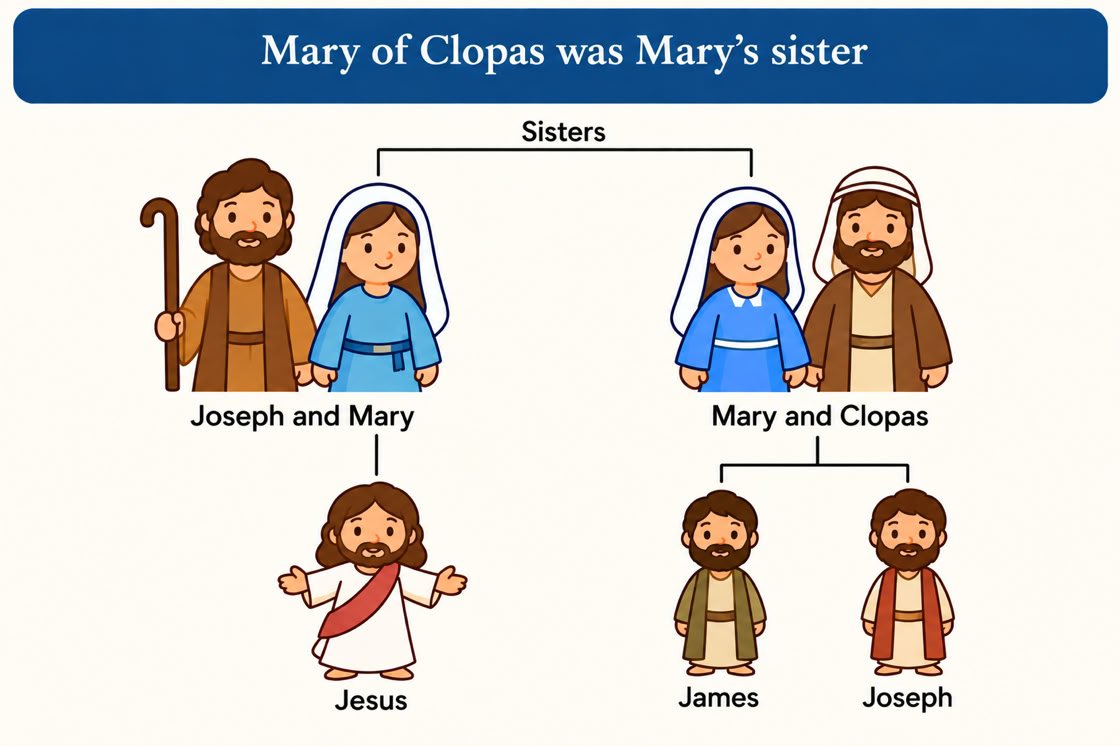
In this case, the Greek text permits two interpretations depending on how it's punctuated. John may be identifying four women: Jesus' mother, her unnamed sister, Mary the wife of Clopas, and Mary Magdalene. Or, he may be identifying only three women: Jesus' mother, her sister Mary (the wife of Clopas), and Mary Magdalene.
If the latter is the correct interpretation, that would make Mary of Clopas the sister of the Virgin Mary.5 Her children would therefore be cousins of Jesus through his mother, and, as we’ve seen, it would have been perfectly natural for a first-century Jew to refer to them as Jesus’s “brothers.”
That Jesus’s “brothers” were technically his cousins was defended in antiquity by St. Jerome, among others. It was also defended by John Wesley, the founder of Methodism. Commenting on Matthew 13:55, where Matthew gives the names of Jesus’ brothers, Wesley wrote:
His brethren—Our kinsmen. They were the sons of Mary, sister to the virgin, and wife of Cleophas or Alpheus.6
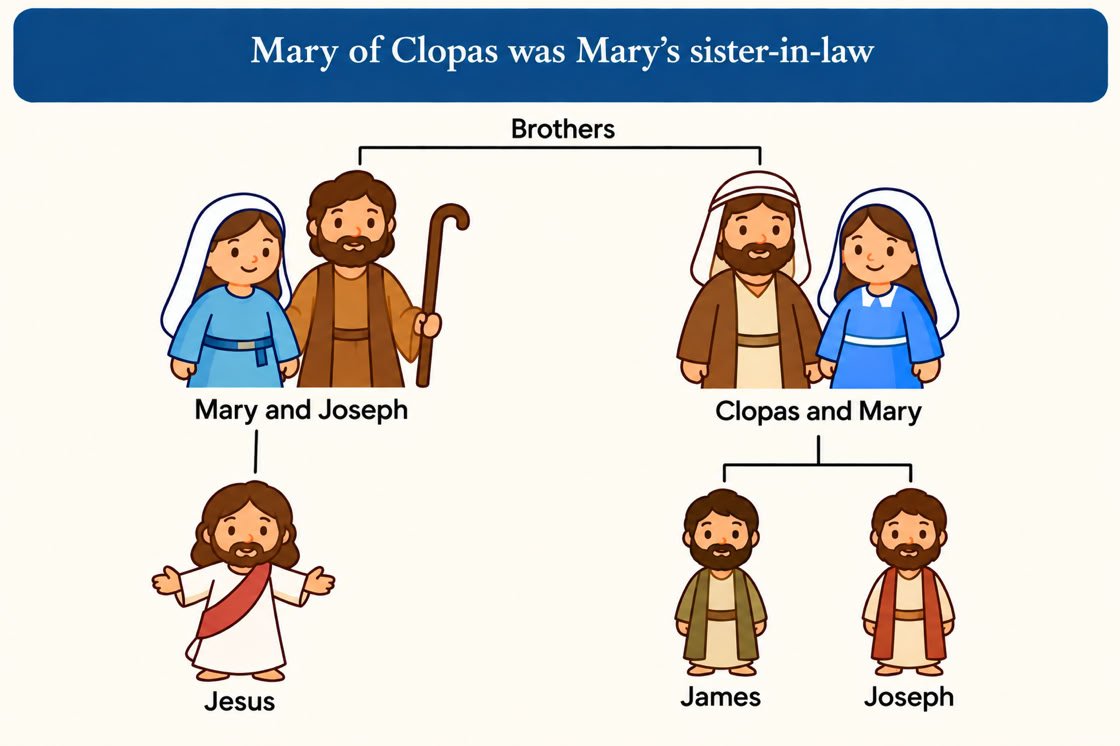
But if the Virgin Mary’s sister and Mary of Clopas weren’t the same person, there’s another possibility. According to the early Christian historian Hegesippus, Clopas was the brother of Joseph.7 That would make Mary of Clopas the Virgin Mary's sister-in-law, and her children cousins of Jesus through his legal father. Again, referring to them as his “brothers” would be perfectly natural.
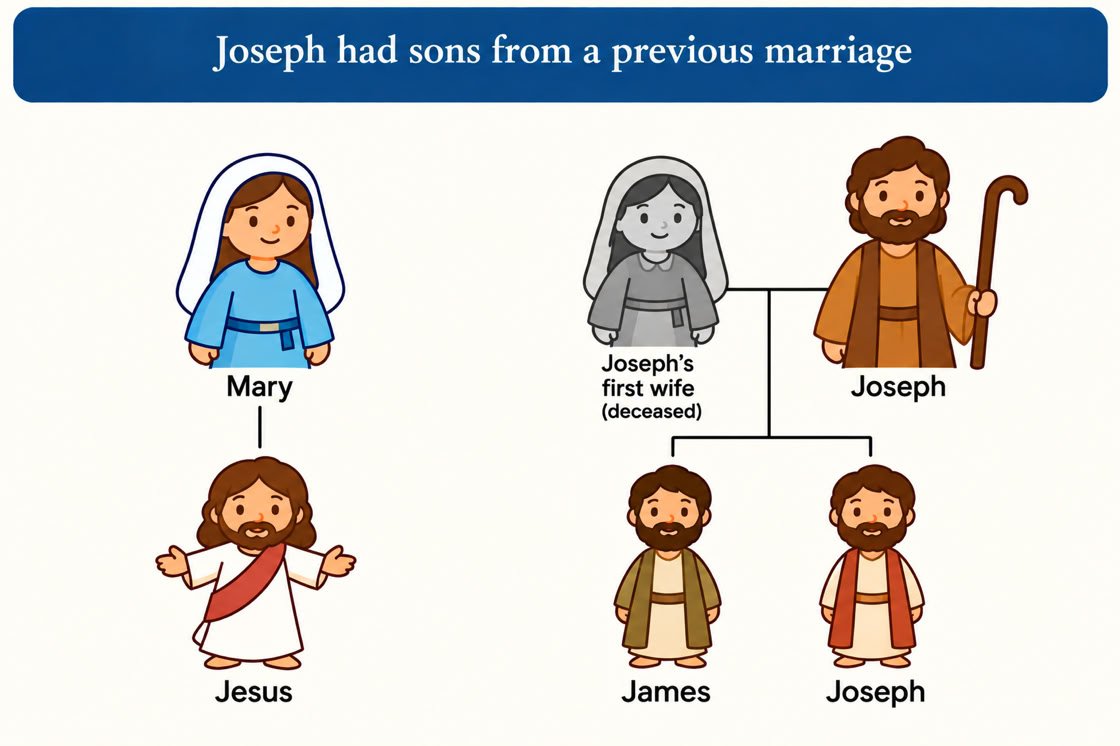
There is also a third possibility. According to an early Christian account, Joseph was a widower who had children from a previous marriage. This explanation appears in the second-century Protoevangelium of James8 and has generally been favored by Eastern Orthodox Christians. If this account is correct, Jesus' brothers and sisters were children of Joseph, but not of Mary. They would therefore have been his stepbrothers and stepsisters.
The first two explanations depend on identifying Mary of Clopas as the mother of James and Joseph. The third doesn't. But all three provide possible explanations for why the Gospels refer to Jesus' brothers and sisters even though they weren't children of the Virgin Mary.
“How can this be?”
Another interesting piece of evidence comes from Mary's reaction to the angel Gabriel's announcement that she would bear a son.
Gabriel told her:
You will conceive and give birth to a son, and you are to call him Jesus (Luke 1:31).
Mary responded:
How will this be, since I am a virgin? (Luke 1:34).
Now, think about that for a moment.
Mary was betrothed to Joseph. Ordinarily, a young woman preparing for marriage would expect to have children. And Gabriel confirmed that she would have a son. Why would that have puzzled her?
After all, she grew up around livestock. She knew how children were conceived.
Some Christian interpreters, including several of the Church Fathers, understood Mary's question as evidence that she had already resolved to remain a virgin. If so, her question makes perfect sense. She wasn't asking how a married woman could have a child. She was asking how she could have a child, given her intention to remain a virgin.9
“Behold your mother”
Perhaps the most intriguing evidence comes from the crucifixion.
John tells us:
When Jesus saw his mother, and the disciple whom he loved standing near, he said to his mother, “Woman, behold, your son!” Then he said to the disciple, “Behold, your mother!” And from that hour the disciple took her to his own home. (John 19:26–27).
Why did Jesus entrust his mother to John?
According to the usual Protestant interpretation, Mary had at least four other sons: James, Joseph, Simon, and Jude. If that were true, why would Jesus place her in the care of someone outside her immediate family?
In Jewish society, caring for one's widowed mother was an important family obligation. Remember how critical Jesus was of the Pharisees for allowing people to evade their obligation to support their parents (Mark 7:9–13). Ordinarily, then, responsibility for Mary's care would fall to her sons. Yet Jesus entrusted Mary to John.
The nineteenth-century Anglican bishop and biblical scholar J. B. Lightfoot considered this a particularly serious difficulty for the belief that Jesus' brothers were also Mary's children. In fact, he described the argument as having a “fatal effect” on that interpretation.10
Lightfoot asked:
Is it conceivable that our Lord would thus have snapped asunder the most sacred ties of natural affection?
One possible explanation is that Jesus' brothers were still unbelievers. John 7:5 tells us that “even his own brothers did not believe in him.” Perhaps Jesus preferred to entrust his mother to a faithful disciple rather than to unbelieving relatives.
But Lightfoot argued that the brothers' unbelief would hardly have overridden their obligation to care for their mother. And even if it had, their unbelief was temporary.
Within a short time, Jesus' brothers had become believers. Acts 1:14 places them alongside Mary among the disciples in Jerusalem.
So why would Jesus entrust Mary to John rather than to her own sons, knowing that they would soon become believers? Why not entrust her to James, who he knew would not only become a member of the Church in Jerusalem, but its leader?
That's the difficulty Lightfoot saw in the Protestant interpretation, and it's why he considered Jesus' decision to entrust Mary to John such a powerful argument against the belief that she had other sons.
Of course, Jesus' decision to entrust Mary to John isn't absolute proof that she had no other sons. But it makes perfect sense if Jesus was Mary's only son, and it is another piece of evidence that fits the ancient Christian understanding better than the alternative.
What the Bible doesn’t say
There is one more observation worth making.
Although the Gospels repeatedly refer to Jesus' brothers and sisters, they never identify any of them as children of Mary, the mother of Jesus.
The New Testament tells us that Jesus was Mary's son. It also tells us that Jesus had brothers and sisters. But nowhere does it say that these brothers and sisters were also Mary's children.
Of course, that omission doesn't prove that Mary had no other children. The Gospel writers were primarily concerned with Jesus, not with providing a complete account of Mary's family.
Nevertheless, the distinction is worth noticing. The conclusion that Jesus' brothers and sisters were also Mary's children is an inference, not something Scripture explicitly states.
Conclusion
So, were the brothers and sisters of Jesus also children of Mary?
At first glance, that seems like the most natural interpretation. But the evidence isn't nearly as straightforward as it initially appears.
In the biblical world, the word “brother” could refer to relatives other than biological siblings. The word “until” in Matthew 1:25 doesn't establish that Joseph and Mary subsequently consummated their marriage. Calling Jesus Mary's “firstborn” doesn't establish that she had additional children. And the Gospels apparently identify another Mary as the mother of James and Joseph, two names also associated with Jesus' brothers.
Mary's question to Gabriel is consistent with an intention to remain a virgin, and Jesus' decision to entrust her to John is easier to understand if she had no other sons.
And this wasn't originally just a Catholic belief. Martin Luther, the father of the Protestant Reformation, affirmed:
Christ ... was the only Son of Mary, and the Virgin Mary bore no children besides Him.11
Luther wasn't alone. Other prominent Protestant Reformers, including John Calvin, Huldrych Zwingli, Heinrich Bullinger, Thomas Cranmer, and Hugh Latimer, also defended Mary's perpetual virginity.
So although the modern Protestant interpretation is still plausible, it’s not nearly as compelling as it first appears. In fact, all things considered, the traditional Christian interpretation may be the more likely explanation after all.
__________
1 John Calvin, Sermon 22 on Matthew 1:22–25, in Ioannis Calvini Opera, vol. 46 (Corpus Reformatorum, vol. 74), pp. 259–272; English translation in Max Thurian, Mary: Mother of All Christians, trans. Nevill B. Cryer (New York: Herder and Herder, 1963), pp. 39–40. https://beggarsallreformation.blogspot.com/2014/10/calvin-there-have-been-certain-strange.html
2 Hugh Latimer, “Sermon on Saint Stephen's Day,” in Sermons and Remains of Hugh Latimer, vol. 2, p. 105. https://upload.wikimedia.org/wikipedia/commons/f/f2/Sermons_by_Hugh_Latimer._%28IA_00916310.1113.emory.edu%29.pdf
3 François Rossier, S.M., “The ‘Brothers’ and ‘Sisters’ of Jesus: Anything New?” Marian Studies 58 (2007): 104–106. https://ecommons.udayton.edu/marian_studies/vol58/iss1/10
4 John Gill, Exposition of the Old and New Testaments, commentary on Matthew 13:55. https://biblehub.com/commentaries/gill/matthew/13.htm
5 Why would two sisters have the same name? They may not have been biological sisters. Just as “brother” could refer to relatives other than biological siblings, “sister” could refer to other female relatives. Mary of Clopas may have been the Virgin Mary's sister-in-law, cousin, or another close relative.
6 John Wesley, Explanatory Notes upon the New Testament, Matthew 13:55. https://www.christianity.com/bible/commentary/john-wesley/matthew/13?utm_source=chatgpt.com
7 Eusebius, Ecclesiastical History 3.11, reporting Hegesippus's tradition that Clopas was Joseph's brother. https://ccel.org/ccel/schaff/npnf201.iii.viii.xi.html
8 Protoevangelium of James, §9, depicting Joseph as an older man who already had children when he was chosen to take Mary into his care. https://www.newadvent.org/fathers/0847.htm
9 St. Augustine, Of Holy Virginity, §4, interpreting Mary's question in Luke 1:34 as evidence that she had already dedicated her virginity to God. https://www.newadvent.org/fathers/1310.htm
10 J. B. Lightfoot, “The Brethren of the Lord,” in St. Paul's Epistle to the Galatians, dissertation II, third objection to the Helvidian theory, discussing John 19:26–27. https://www.biblestudytools.com/classics/lightfoot-dissertations-on-the-apostolic-age/the-brethren-of-the-lord.html
11 Martin Luther, Sermons on the Gospel of St. John, commenting on John 2:12, in Luther's Works, vol. 22, pp. 214–215, ed. Jaroslav Pelikan (St. Louis: Concordia Publishing House, 1957). https://beggarsallreformation.blogspot.com/2014/09/luther-christwas-only-son-of-mary-and.html
Copyright © 2024–[YEAR] Catholicoutlook.me