Scripture and Tradition
Scripture and Tradition

Scripture and Tradition

Catholic Outlook
Catholic Outlook
Does the New Testament Contain Everything We Need to Know?
Examining the sufficiency of Scripture alone
Part 2 of a four-part series testing the assumptions on which sola Scriptura rests
The Protestant doctrine of sola Scriptura holds that the Bible is our only rule of faith and practice. And Protestants claim that the Bible is sufficient for that purpose, that it contains everything Christians need to know.
Not everything about everything, of course. They aren’t saying the Bible can tell you how to repair your car, do your taxes, or cook a roast. That’s not what Protestants mean by “sufficient.” Pastor Nathan Williams of Woodhaven Bible Church explains:
When Protestants teach that God’s Word is sufficient, we aren’t saying that the Bible provides all the answers for every possible question in life. This should be obvious, but often must be stated. Scriptural sufficiency is both limited and comprehensive. It’s limited in that it speaks to two areas: salvation and godly living. It’s comprehensive in that it provides all we need for both eternal life and how to live before God in holiness now.1
Williams goes on to quote the 1689 London Baptist Confession of Faith, which makes clear that these teachings need not be explicitly stated in Scripture, as long as they can be necessarily derived from it:
The whole counsel of God concerning all things necessary for his own glory, man’s salvation, faith and life, is either expressly set down or necessarily contained in the Holy Scripture.2
Is that true? Maybe. But we can’t just assume that it is because sola Scriptura wouldn’t work otherwise. If sola Scriptura is correct, the doctrine of Scripture’s sufficiency must itself be supported by Scripture. So what do we find when we read through the New Testament?
What I expected to find
I’ll never forget the first time I read through the New Testament as a new Christian. I had been taught that the Bible was our only rule of faith and practice, so I naturally expected the New Testament to provide a reasonably clear and complete account of what Christians were supposed to believe and practice.
But I was struck by how random it seemed. We had four short biographies of Jesus, an account of the early days of the Church, and then a collection of letters written to different people and communities, usually addressing specific questions, controversies, or abuses.
There was no systematic outline of the Christian faith, no explanation of which teachings were central and which were secondary, or how they all fit together. Instead, it was like a jigsaw puzzle without the helpful picture on the front of the box to show you what it was supposed to look like when you put it all together.
In fact, I couldn’t see any suggestion in Scripture itself that if we put all the pieces together, we’d end up with a complete and clear account of Christian faith and practice. Did we just assume that must be true, since the Bible was our only rule of faith and practice? And if so, was that an assumption the New Testament itself gave us any reason to make?
To answer that question, we need to consider how the New Testament came to be, why its books were written, and what their authors could reasonably take for granted about the knowledge of their original readers.
Christianity came before the New Testament
The Christian Church obviously didn’t begin with a collection of writings. It began with the preaching of the apostles.
On Pentecost, Peter proclaimed the gospel to the crowds in Jerusalem, and about three thousand people were baptized (Acts 2:41). Those new Christians devoted themselves to “the apostles’ teaching and to fellowship, to the breaking of bread and to prayer” (Acts 2:42).
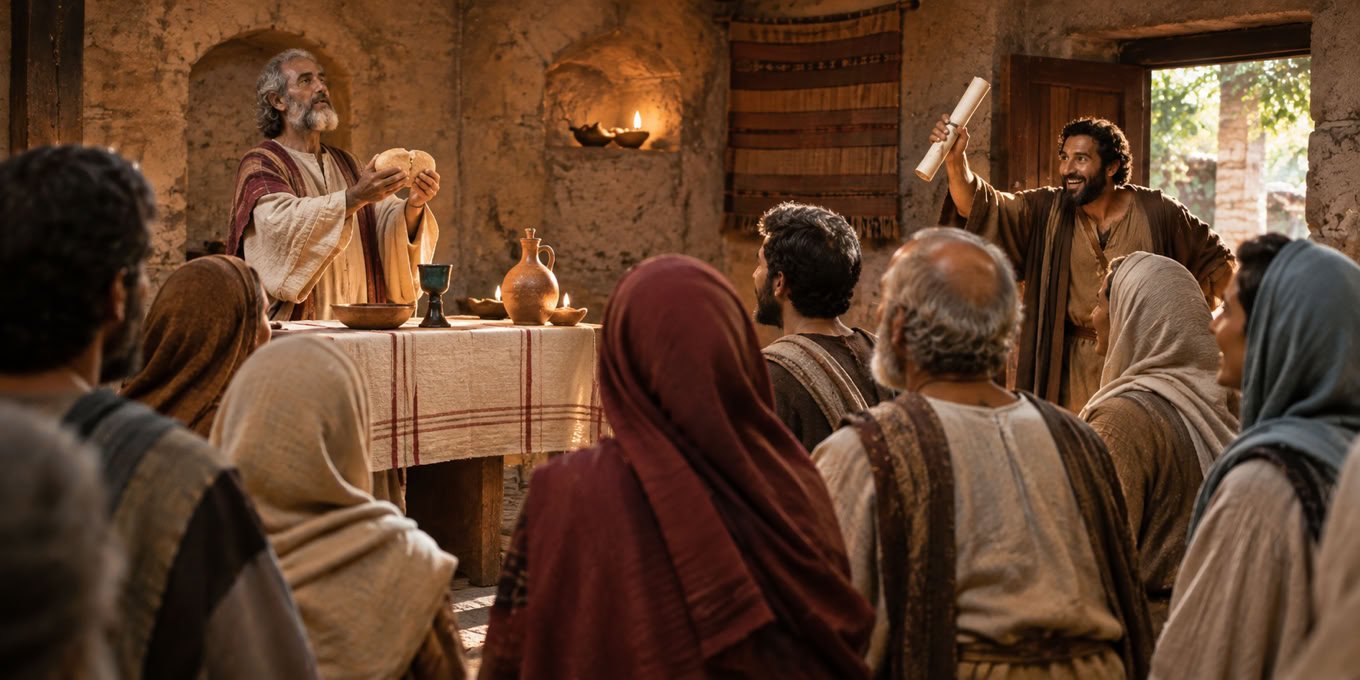
As Christianity spread, the apostles and their coworkers established communities of believers throughout the Roman world. They preached the gospel, baptized converts, instructed them in the faith, celebrated the Lord’s Supper, and taught Christians how to live.
All of this was happening before most of the New Testament had been written.
Who were the New Testament writers writing to?
This is where the circumstances in which the New Testament was written become especially important.
When Paul wrote to the Corinthians, Galatians, Philippians, or Thessalonians, he wasn’t introducing Christianity to people who had never heard of it. He was writing to established Christian communities whose members had already received instruction from him or his coworkers.
His letters generally addressed particular circumstances. Sometimes he was correcting abuses. Sometimes he was answering questions, settling disputes, or encouraging believers who were facing difficulties.
And sometimes he was simply reminding his readers of things he’d already taught them.
For example, when Paul wrote to the Thessalonians about the events preceding Christ’s return, he asked:
Don’t you remember that when I was with you I used to tell you these things? (2 Thessalonians 2:5)
Paul had evidently explained these matters when he was with them. His letter refers to that earlier instruction without repeating everything he’d said.
Or consider his instructions to the Corinthians about abuses surrounding the Lord’s Supper. After correcting several problems, Paul concluded:
And when I come I will give further directions. (1 Corinthians 11:34)
He didn’t feel compelled to put every instruction in writing. He could give additional directions when he arrived. Wouldn’t you love to know what he said?
John expressed a similar preference:
I have much to write to you, but I do not want to use paper and ink. Instead, I hope to visit you and talk with you face to face, so that our joy may be complete. (2 John 12)
He expressed the same preference in 3 John 13–14.
These weren’t authors attempting to produce a complete written account of Christianity for people who knew nothing about it. They were communicating with Christians who had already received instruction in the faith.
And that makes a difference.
Why would the apostles write down what everyone already knew?
Remember that writing in the first century wasn’t like writing today. The biblical writers couldn’t go to Walmart and buy a ream of paper and a ballpoint pen. They had to write on papyrus or parchment, often using a reed pen dipped in ink. Writing was laborious, materials were expensive, and there was only so much room on a scroll.3
So the apostles had good reason to be economical with their words. They certainly repeated important teachings when there was a reason to do so. But why would they devote considerable time and expensive materials to explaining everything their readers already knew?
When a particular doctrine or practice was already understood and accepted, there might have been no reason to mention it. In fact, the more universally understood something was, the less reason there would have been to explain it in a letter.
That means we can’t assume that the New Testament contains a complete account of everything the apostles considered necessary for Christian faith and practice. Some teachings may have been mentioned only briefly—or not at all—simply because their readers already understood them.
What about infant baptism?
Here’s a great example. The New Testament repeatedly commands baptism and describes its importance. But it never explicitly tells Christian parents whether they should baptize their infants.
And why should it?
Consider the question from the perspective of the earliest Christian communities. Unlike us, who have to determine what the apostles taught about infant baptism from writings that didn’t specifically address the question, those Christians already knew what the apostles taught because they were the ones they taught.
It’s not so easy for us. But just think how easily the question could have been settled. All we would need is one sentence, somewhere in the New Testament, telling Christian parents either to baptize their infants or to wait until their children were old enough to profess faith for themselves. Just one sentence.
But that sentence isn’t there.
And why not? Well, probably for the same reason modern Presbyterian parents don’t need a letter from their pastor explaining that their church baptizes infants. They already know that. Even those of us who aren’t Presbyterians know.
And if their pastor wrote them a letter about something else, he wouldn’t necessarily explain that Presbyterians baptize infants, because, again, his readers already know that.
The same was true of the Christians to whom the apostles wrote. We may not know whether their churches baptized infants, but they knew.
The New Testament authors could take for granted knowledge that later Christians wouldn’t necessarily possess. And that could affect what they chose to write down.
What does the evidence suggest?
The apostles established Christian communities and taught their converts the faith before most of the New Testament had been written.
The New Testament authors generally wrote to people who had already received that instruction. They addressed particular problems, answered questions, corrected misunderstandings, and reinforced teachings their readers already knew.
Sometimes they explicitly referred to things they’d taught in person without repeating them. And sometimes they told their readers that they’d provide further instruction when they saw them.
Taken together, what does that evidence suggest?
It suggests that the New Testament writings were intended to supplement and reinforce a faith their original readers already possessed, not to teach Christianity from scratch.
There’s no suggestion that they were intended to contain everything Christians need to know and communicate it to future generations all by themselves, without the background knowledge their original readers possessed.
That’s a much broader claim, but that’s what sola Scriptura requires.
Of course, God could have intended something more than the human authors themselves understood. He could have inspired them in such a way that their collected writings would contain everything Christians would ever need to know about faith and practice, even though they weren’t consciously attempting to produce such a collection.
But saying that it could have happened isn’t the same as proving that it did.
And the evidence we’ve examined points toward a more limited purpose for the individual writings. We’ve seen nothing to suggest that God intended the completed collection to serve as a self-contained account of the entire Christian faith.
A claim Scripture must establish
But that’s exactly what the 1689 London Baptist Confession of Faith asserts:
The whole counsel of God concerning all things necessary for his own glory, man’s salvation, faith and life, is either expressly set down or necessarily contained in the Holy Scripture.2
Where do they get that idea? Not, it would seem, from Scripture itself. And that’s a serious problem for sola Scriptura. If every Christian doctrine must be established from Scripture, the claim that Scripture contains everything necessary for Christian faith and practice must also be established from Scripture.
The burden of proof rests with those making that claim, not with those questioning it. And by their own standards, they need to prove it from Scripture.
Letting Scripture be what it was meant to be
What if we’ve been expecting something from the Bible that it was never intended to provide?
The New Testament wasn’t written to introduce Christianity to people who knew nothing about it. Its authors were writing to Christians who had already been taught the faith and were living it. And they didn’t just write letters. They preached, baptized, celebrated the Lord’s Supper, and established Christian communities. Their writings were part of that larger work.
And perhaps that’s how we should understand them: not as a replacement for the faith they taught in person, but as inspired writings that supplement, reinforce, and illuminate it.
Remember my experience of reading the New Testament for the first time? I compared it to a jigsaw puzzle without the picture on the front of the box. I was trying to assemble the pieces without knowing what the finished picture was supposed to look like.
But the earliest Christians weren’t in that position. They already knew the faith the apostles had taught them. They had the picture on the box, so to speak.
And that same faith, preserved and passed down within the Church, provides the context in which we can understand the New Testament today. It helps us see how the pieces—written and unwritten—fit together and what the completed picture is supposed to look like.
The Bible doesn’t become less valuable because we recognize the circumstances in which it was written. On the contrary, understanding those circumstances helps us appreciate what Scripture was intended to accomplish.
We don’t have to ask Scripture to be something it was never meant to be in order to receive everything God intended to give us through it.
In this series:
1. Does Scripture Alone Teach “Scripture Alone”? — Biblical basis
2. Does the New Testament Contain Everything We Need to Know? — Completeness
3. Why Can’t We Agree on the Clear Teachings of Scripture? — Clarity
4. Who Has the Final Say When Christians Disagree? — Who settles disputes?
__________
1 Nathan Williams, “The Sufficiency of Scripture,” Woodhaven Bible Church, April 25, 2024. Williams explains the Protestant understanding of Scripture's sufficiency and quotes the 1689 London Baptist Confession of Faith.
2 Second London Baptist Confession of Faith (1689), Chapter 1, paragraph 6, “Of the Holy Scriptures.”
3 For the writing materials and methods used in antiquity, see the Berlin Papyrus Database, “Writing Materials.” Papyrus was widely used for letters, with ink and reed pens. Parchment was another available material, though generally more expensive.
Featured Articles
Copyright © 2024–[YEAR] Catholicoutlook.me