Mary and the Saints
Mary and the Saints
Mary and the Saints
Mary and the Saints
Mary and the Saints
Mary and the Saints
Mary and the Saints

Catholic Outlook

Catholic Outlook
Catholic Outlook
All Christians Believe in the Assumption of Mary
Some just don’t think it’s happened yet
Many Protestants reject the Catholic doctrine of the Assumption of Mary, which teaches that at the end of her earthly life, Mary was taken, body and soul, into heaven. Some regard this as an unbiblical Catholic invention.
But here's something interesting: Nearly all Christians believe that one day they, too, will be taken bodily into heavenly glory.
It just hasn't happened yet.
The resurrection of the body
Christians disagree about many things, but there's one belief that nearly all of them share: One day, God will raise the dead, transform their bodies, and bring his people into heavenly glory.
Catholics believe this. Orthodox Christians believe it. Protestants believe it. It's part of the historic Christian faith, expressed in both the Apostles' Creed and the Nicene Creed.
The apostle Paul describes this transformation in his first letter to the Corinthians:
Listen, I tell you a mystery: We will not all sleep, but we will all be changed—in a flash, in the twinkling of an eye, at the last trumpet (1 Corinthians 15:51–52).
Notice that Paul says we will not all sleep. In other words, not everyone will experience death before receiving a glorified body.
The Rapture
Many evangelical Christians believe in an event commonly called the Rapture. According to this belief, when Christ returns, believers who are still alive will be caught up to meet him without first experiencing death.
The biblical basis for this belief is found in Paul's first letter to the Thessalonians:
After that, we who are still alive and are left will be caught up together with them in the clouds to meet the Lord in the air. And so we will be with the Lord forever (1 Thessalonians 4:17).
Christians disagree about the timing and circumstances of this event. Some believe it will occur before a period of tribulation, others believe it will occur afterward, and still others reject the popular end-times scenario associated with the Rapture.
But the underlying belief is much more widespread: When Christ returns, those who belong to him will share in his victory over death, and their bodies will be transformed and glorified.
In other words, Christians already believe that God will bring his people bodily into heavenly glory. Some will first experience death and resurrection. Others will be transformed without dying.
And that raises an interesting question.
Why not Mary?
If God can take millions of Christians bodily into heavenly glory at Christ's return, why couldn't he have done the same thing for the mother of Jesus nearly two thousand years earlier?
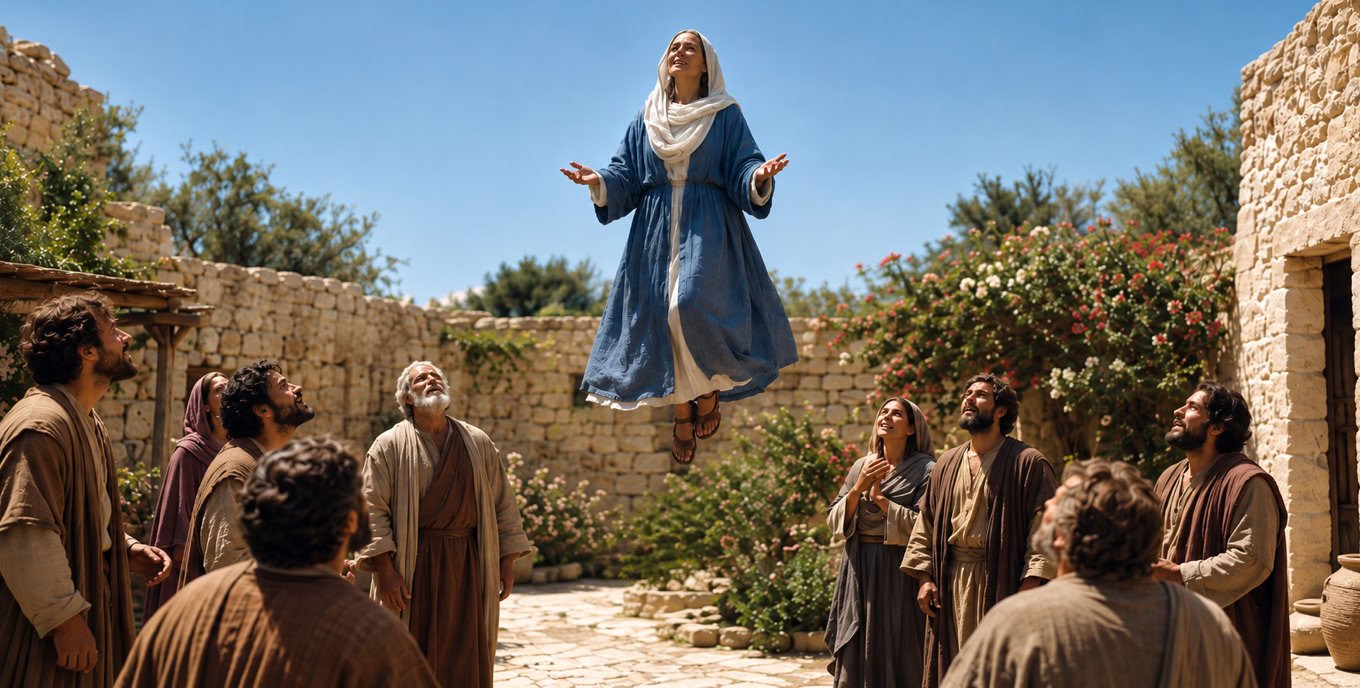
The Catholic Church teaches that Mary, at the end of her earthly life, was assumed body and soul into heavenly glory. It doesn't require Catholics to believe that she never died. In fact, the longstanding tradition in both Eastern and Western Christianity is that Mary did experience death before being taken into heaven.
Nor does the Church teach that Mary ascended into heaven by her own power, as Jesus did. Jesus ascended; Mary was assumed. She was taken into heaven by the power of God.
And the Bible already provides examples of God taking people from this earthly life in extraordinary ways.
Enoch "was taken from this life, so that he did not experience death" (Hebrews 11:5). Elijah was taken up to heaven in a whirlwind (2 Kings 2:11).
So the idea that God could take someone bodily from this world isn't foreign to Scripture. And the idea that someone could receive heavenly glory ahead of the general resurrection isn't inherently impossible.
The real question
Of course, none of this proves that Mary was assumed into heaven. Demonstrating that God could have done something, or that he’s done it before, isn't the same as demonstrating that he did it again.
And a Protestant might reasonably respond that Scripture explicitly describes what happened to Enoch and Elijah and promises the future transformation of believers, but doesn't explicitly describe Mary's Assumption.
That's a legitimate distinction. The Catholic case for the Assumption involves more than these biblical parallels. It also involves the Church's understanding of Mary, the testimony of Christian tradition, and the authority of the Church to define doctrine.
But the parallels do establish something important.
The Assumption isn't an absurd or inherently unbiblical idea. The Bible itself describes extraordinary departures from earthly life and promises that believers will one day share bodily in Christ's heavenly glory.
Christians already believe in the Assumption of Everyone. They expect God to do for the rest of his people what Catholics say he has already done for Mary.
So, in a sense, all Christians believe in the Assumption of Mary—some just don't think it's happened yet.
Featured Articles
Copyright © 2024–[YEAR] Catholicoutlook.me