The Sacraments
The Sacraments
Common Objections
Common Objections
The Sacraments

Catholic Outlook

Catholic Outlook
Catholic Outlook
Must Baptism Be by Full Immersion?
Does the meaning of the Greek word determine how baptism must be performed?
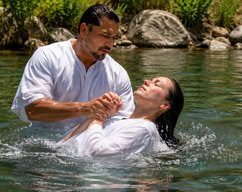
Christians have traditionally baptized in more than one way. Some churches ordinarily baptize by completely immersing the person in water, while others typically pour water over the person's head. But these aren't necessarily exclusive practices. Catholics, for example, ordinarily baptize by pouring, but they also recognize immersion as perfectly valid. Likewise, the Orthodox Churches and many Protestant denominations, including Lutherans, Methodists, Presbyterians, and Anglicans, recognize both methods.
But some Christians, particularly Baptists and members of certain nondenominational churches, insist that baptism must be performed by full immersion to be valid. They argue that the Greek word translated “baptize,” baptizō (βαπτίζω), means “to immerse.” Therefore, anything less than complete immersion isn't really baptism.
The first part of that argument is true. The Greek word baptizō commonly means “to immerse” or “to dip.” And there's no question that baptism by full immersion is valid. In fact, one could reasonably argue that it's preferable because it provides a more vivid representation of what Paul describes in Romans 6:3–4:
Or don't you know that all of us who were baptized into Christ Jesus were baptized into his death? We were therefore buried with him through baptism into death in order that, just as Christ was raised from the dead through the glory of the Father, we too may live a new life.
Going beneath the water symbolizes being buried with Christ, while emerging from it symbolizes rising to new life. It's a beautiful representation of what happens in baptism.
The Catholic Church recognizes this. In fact, the Catechism states that baptism is performed “in the most expressive way by triple immersion in the baptismal water” (CCC 1239).1
But there's a considerable difference between saying that immersion is a valid, meaningful, or even preferable way to baptize and saying that it's the only valid way.
And we can't establish the latter simply by appealing to the ordinary meaning of a Greek word.
When words acquire religious meanings
There's a logical error known as the etymological fallacy, which occurs when someone assumes that a word's meaning must be determined by its origin rather than by how it's actually used.
But word meanings can change over time. For example, King Charles II supposedly described St. Paul's Cathedral as “awful, artificial, and amusing”—and meant all three words as compliments. At the time, awful could mean awe-inspiring, artificial could mean skillfully made, and amusing could mean pleasing. Today that same description would sound insulting.
A related mistake is assuming that a word's ordinary meaning must govern every specialized use of that word. This is particularly relevant when words are adopted to describe religious practices or institutions.
This is particularly relevant when ordinary words acquire specialized religious meanings.
We find several examples of this in Christianity itself.
Consider the Greek word ekklēsia (ἐκκλησία), which we translate as “church,” and from which we get words like ecclesiastical. In ordinary Greek, it referred to an assembly of people, often a civic gathering. In fact, Acts 19:32 uses the word to describe a disorderly crowd gathered in Ephesus.
But Christians adopted the word to describe something much more specific: the community of believers united in Christ.
Paul could write to the church in Corinth even when its members weren't physically assembled. He could also speak of the Church as the body of Christ (Ephesians 1:22–23), encompassing believers in different places.
So although ekklēsia ordinarily meant an assembly, the Church doesn't cease to exist when its members go home. The word acquired a specifically Christian meaning that went beyond its ordinary usage.
Or consider koinōnia (κοινωνία), a Greek word meaning “fellowship,” “sharing,” or “participation.” Paul uses it in 1 Corinthians 10:16 when speaking of our participation in the body and blood of Christ. From this idea comes the familiar Christian term “Communion,” which Protestants and Catholics alike use for the Lord's Supper.
But Communion isn't simply fellowship in the ordinary sense. It's a particular Christian rite involving bread and wine, instituted by Jesus himself. When Christians speak of receiving Communion, they mean something much more specific than enjoying fellowship with other believers.
Another example is euangelion (εὐαγγέλιον), the Greek word translated “gospel,” and from which we get words like evangelism. It means “good news,” and in ordinary Greek it could refer to any number of welcome announcements, including military victories or important political events.
But when Christians speak of preaching the gospel, they don't mean announcing just any good news. They mean proclaiming the good news of salvation through Jesus Christ.
In each case, an ordinary Greek word acquired a specifically Christian meaning. Its original meaning wasn't necessarily discarded, but its Christian usage wasn't confined to that meaning either.
And that brings us back to baptism.
Although baptizō commonly meant “immerse,” Christians adopted the word to describe a particular religious rite. That rite involved considerably more than submerging someone in water. Scripture associates it with cleansing from sin (Acts 22:16), union with Christ in his death and resurrection (Romans 6:3–4), and receiving the Holy Spirit (Acts 2:38).
So it's entirely possible that baptizō, like these other words, acquired a specialized Christian meaning that wasn't limited to its ordinary physical sense.
But did it?
We don't have to speculate. We can examine how the earliest Christians actually used the word and practiced baptism.
How did the earliest Christians understand baptism?
One of our earliest sources is a Christian document called the Didache, generally dated to the late first or early second century. That places it remarkably close to the time of the apostles.2
The Didache contains instructions on Christian worship, morality, and church life, including how baptism should be administered:
And concerning baptism, baptize this way: Having first said all these things, baptize into the name of the Father, and of the Son, and of the Holy Spirit, in living water. But if you have not living water, baptize into other water; and if you can not in cold, in warm. But if you have not either, pour out water thrice upon the head into the name of Father and Son and Holy Spirit.3
The author clearly prefers baptism in living, or flowing, water. But when the preferred arrangements aren't available, he explicitly instructs Christians to pour water over the person's head three times.
He doesn't say that pouring is something other than baptism, or that it produces an inferior or invalid baptism. He simply explains how to baptize under different circumstances.
Particularly significant is the fact that the Didache was written in Greek, the very language in which the New Testament was written. Its author wasn't struggling with the meaning of an unfamiliar foreign word, and he saw no contradiction between the instruction to baptize and the instruction to pour water over someone's head.
If the meaning of baptizō necessarily excluded pouring, how do we explain that?
Of course, the Didache doesn't establish that pouring was the usual way Christians baptized. In fact, its instructions suggest a preference for baptism in a body of water. But that's not the question we're trying to answer.
The question is whether complete immersion was considered indispensable to the validity of baptism. And here we have remarkably early evidence that it wasn't.
The testimony of Cyprian and others
We find further evidence in the writings of Cyprian, bishop of Carthage in North Africa, around AD 255.
Cyprian was asked whether people who had received baptism by sprinkling or pouring while seriously ill should be regarded as validly baptized. These were sometimes called clinical baptisms, because they were administered to people confined to their beds. This raises an interesting question: What about someone who, because of illness or disability, cannot safely be immersed? Does that mean he’s just out of luck?
Cyprian's answer was that such baptisms were valid. He argued that the effectiveness of baptism depended on God's grace, not on the quantity of water used.4
He also appealed to the Old Testament, particularly Ezekiel 36:25, where God promises:
I will sprinkle clean water on you, and you will be clean; I will cleanse you from all your impurities and from all your idols.
Cyprian understood sprinkling as a legitimate biblical image of spiritual purification. Consequently, he saw no reason to regard baptism administered in this manner as invalid.
His answer is particularly interesting because it shows that the question of baptismal method was being discussed in the early Church. Not everyone was necessarily in agreement. But Cyprian, an important third-century bishop, defended the validity of baptism without full immersion.
And he didn't defend it by arguing that the Greek word baptizō didn't mean “immerse.” He defended it by appealing to what baptism accomplished and to the biblical imagery of cleansing.
Nor are these our only ancient witnesses. Around the same time, Cornelius, bishop of Rome, described how Novatian had received baptism by pouring while seriously ill, although Cornelius questioned aspects of his baptism.5 In the fourth century, councils at Neocaesarea and Laodicea also discussed baptisms administered during illness, without specifying how the water was applied.6 We also have early Christian artwork that has been interpreted as depicting water being poured over baptismal candidates.7
Did the early Christians forget how to baptize?
Baptism was one of the most basic practices of Christianity, and the apostles personally instructed the churches they established. If they had taught that baptism was valid only when someone was completely submerged in water, it's difficult to believe that Christians would have forgotten such an essential requirement within a generation or two.
Are we to believe that Christians had already forgotten how the apostles taught them to baptize? Or is it more likely that the apostles never insisted on complete immersion as an absolute requirement in the first place?
Conclusion
Studying the Greek words used in the New Testament can help us understand Scripture more accurately. But as we've seen, ordinary words can acquire specialized religious meanings, and we can't assume that every aspect of a religious practice must conform to the ordinary meaning of the word used to describe it.
The question isn't whether baptizō commonly means “immerse.” It does. Nor is it whether full immersion is a valid way to baptize. Of course it is.
The question is whether complete immersion is the only valid way.
And the historical evidence gives us good reason to believe that it isn't. The Christians who lived closest to the apostles knew what baptizō meant. They also knew how to baptize. And they recognized that it didn't have to be by immersion.
__________
1 Catechism of the Catholic Church, 1239. The paragraph explicitly recognizes both triple immersion and pouring water three times over the candidate's head. https://www.vatican.va/content/catechism/en/part_two/section_two/chapter_one/article_1/iii_how_is_the_sacrament_of_baptism_celebrated.index.html
2 The Didache, introduction and dating discussion. The document is commonly dated to the late first or early second century, although its precise date and place of composition remain disputed. https://www.newadvent.org/cathen/04779a.htm
3 Didache, 7:1–3, translated by M. B. Riddle, in Ante-Nicene Fathers, vol. 7. The quotation follows the published translation. The Greek text uses baptizō for the rite and ekcheō for pouring water. https://www.newadvent.org/fathers/0714.htm
4 Cyprian of Carthage, Letter to Magnus, 12–13, traditionally numbered Epistle 75 in the Ante-Nicene Fathers edition and Epistle 69 in the Oxford numbering. Cyprian explicitly defends baptism by sprinkling or pouring when necessity requires it and appeals to Ezekiel 36:25–26 and other passages. https://www.newadvent.org/fathers/050675.htm
5 Eusebius, Church History, 6.43.14–15, preserving Cornelius of Rome's account of Novatian's baptism by affusion while seriously ill. Cornelius questions the circumstances of the baptism and notes that Novatian had not subsequently received the customary episcopal sealing. The passage documents the practice but should not be treated as Cornelius's unqualified endorsement of its validity. https://www.newadvent.org/fathers/250106.htm
6 Council of Neocaesarea, Canon 12, and Council of Laodicea, Canon 47. Both address baptism administered during illness. Neocaesarea restricts the subsequent ordination of such persons, while Laodicea instructs those who recover to learn the Creed. Neither canon specifies pouring or sprinkling as the method. [Neocaesarea](https://www.newadvent.org/fathers/3803.htm; [Laodicea] https://www.newadvent.org/fathers/3806.htm
7 Philip Schaff, History of the Christian Church, vol. 2, Ante-Nicene Christianity, § 72, note 432. Schaff discusses early baptismal paintings in the Roman catacombs depicting water being poured over candidates, while acknowledging that the images do not establish whether immersion also occurred. https://ccel.org/ccel/schaff/hcc2/hcc2.v.vii.xii.html

Featured Articles
Copyright © 2024–[YEAR] Catholicoutlook.me