The Church
The Church
The Church
The Church
The Church
The Church

The Church

Catholic Outlook

Protestant Scholars Agree: Peter is the Rock
Quotations from Protestant Scholars who agree that Matthew 16:18 refers to Peter personally
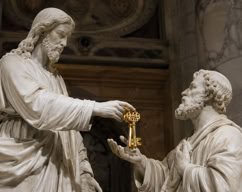
When Jesus asked his disciples, “But who do you say that I am?” Simon answered, “You are the Christ, the Son of the living God.” Jesus replied:
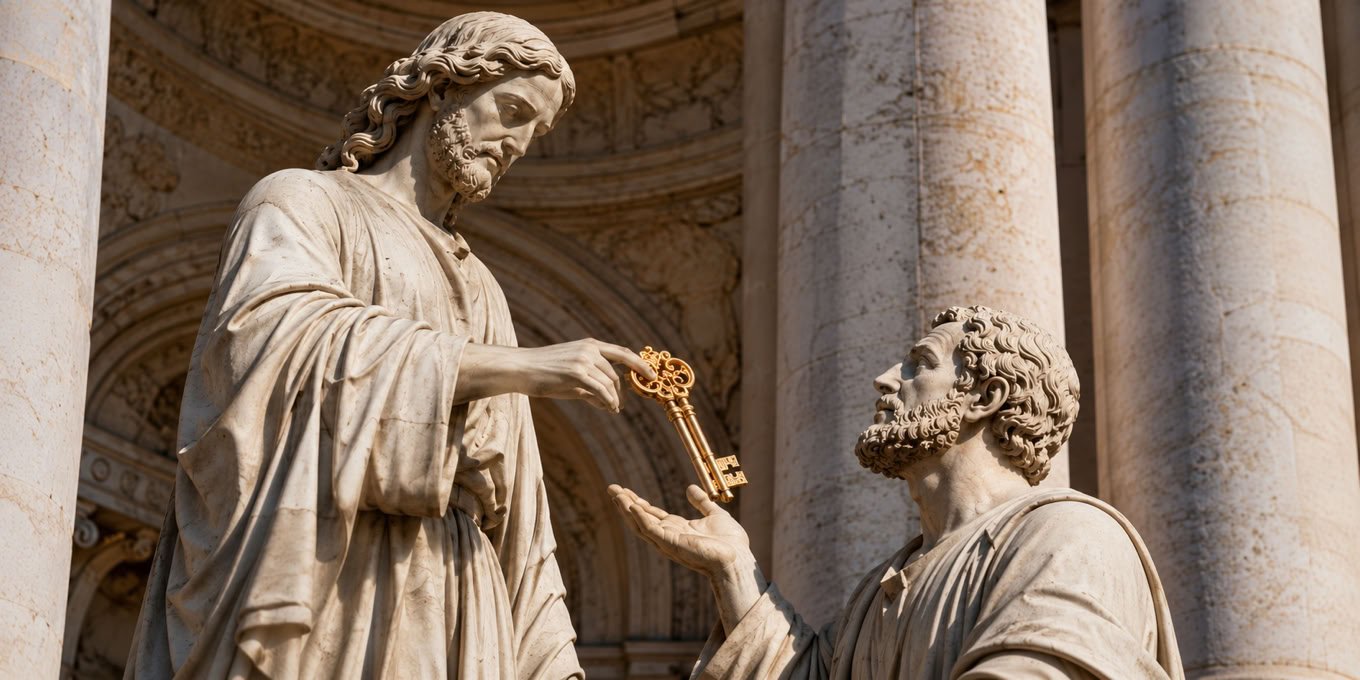
Blessed are you, Simon son of Jonah, for this was not revealed to you by flesh and blood, but by my Father in heaven. And I tell you that you are Peter (Petros), and on this rock (petra) I will build my church, and the gates of Hades will not overcome it. I will give you the keys of the kingdom of heaven; whatever you bind on earth will be bound in heaven, and whatever you loose on earth will be loosed in heaven (Matthew 16:17–19).
Who or what is the “rock” on which Jesus said he would build his church? Catholics have traditionally understood Jesus to be referring to Simon himself. By giving Simon the name Peter—“Rock”—and then saying, “on this rock I will build my church,” Jesus was identifying Peter as the rock.
Other Christians have interpreted the passage differently. Some have argued that the rock is Peter’s confession of faith—“You are the Christ, the Son of the living God”—while others have identified the rock with Christ himself. One argument traditionally offered against identifying the rock with Peter is the difference between the Greek words Petros, Peter’s name, and petra, the word translated “rock.”
But as I explain in “I Tell You That You Are Peter,” that distinction provides little support for separating Peter from the rock. Jesus probably spoke these words in Aramaic, in which the same word, kepha, likely stood behind both: “You are Kepha, and on this kepha I will build my church.” The shift from Petros to petra in Greek is readily explained by grammatical gender and does not imply a contrast between Peter and the rock.
Nor is the identification of Peter as the rock peculiar to Catholic scholarship. Many Protestant biblical scholars likewise conclude that Peter himself is the primary referent of “this rock” in Matthew 16:18. That does not mean they accept the Catholic doctrine of the papacy or agree with Catholics about all the implications of the passage. It means that on the narrower exegetical question—who is the rock?—they agree that the most natural reading is Peter.
The following quotations are from Protestant biblical scholars who identify Peter personally as the rock of Matthew 16:18.
William F. Albright
Methodist biblical archaeologist
Peter as Rock will be the foundation of the future community. Jesus, not quoting the Old Testament, here uses Aramaic, not Hebrew, and so uses the only Aramaic word which would serve his purpose. In view of the background of vs. 19, one must dismiss as confessional interpretation any attempt to see this rock as meaning the faith, or the Messianic confession, of Peter. (W. F. Albright and C. S. Mann, Matthew [Garden City, NY: Doubleday & Co., 1971], 195.)
Craig L. Blomberg
Baptist and Professor of New Testament, Denver Seminary
Acknowledging Jesus as The Christ illustrates the appropriateness of Simon’s nickname “Peter” (Petros = rock). This is not the first time Simon has been called Peter (cf. John 1:42), but it is certainly the most famous. Jesus’ declaration, “You are Peter,” parallels Peter’s confession, “You are the Christ,” as if to say, “Since you can tell me who I am, I will tell you who you are.” The expression “this rock” almost certainly refers to Peter, following immediately after his name, just as the words following “the Christ” in v. 16 applied to Jesus. The play on words in the Greek between Peter’s name (Petros) and the word “rock” (petra) makes sense only if Peter is the rock and if Jesus is about to explain the significance of this identification. (Craig L. Blomberg, Matthew, vol. 22 of The New American Commentary [Nashville: Broadman, 1992], 251–52.)
John A. Broadus
Baptist author
Many insist on the distinction between the two Greek words, thou art Petros and on this petra, holding that if the rock had meant Peter, either petros or petra would have been used both times, and that petros signifies a separate stone or fragment broken off, while petra is the massive rock. But this distinction is almost entirely confined to poetry, the common prose word instead of petros being lithos; nor is the distinction uniformly observed.
But the main answer here is that our Lord undoubtedly spoke Aramaic, which has no known means of making such a distinction [between feminine petra and masculine petros in Greek]. The Peshitta (Western Aramaic) renders, “Thou are kipho, and on this kipho.” The Eastern Aramaic, spoken in Palestine in the time of Christ, must necessarily have said in like manner, “Thou are kepha, and on this kepha.” . . . Beza called attention to the fact that it is so likewise in French: “Thou art Pierre, and on this pierre”; and Nicholson suggests that we could say, “Thou art Piers (old English for Peter), and on this pier.” (John A. Broadus, Commentary on the Gospel of Matthew [Valley Forge, PA: Judson Press, 1886], 355–56.)
Donald A. Carson III
Baptist and Professor of New Testament at Trinity Evangelical Seminary
Although it is true that petros and petra can mean “stone” and “rock” respectively in earlier Greek, the distinction is largely confined to poetry. Moreover the underlying Aramaic is in this case unquestionable; and most probably kepha was used in both clauses (“you are kepha” and “on this kepha”), since the word was used both for a name and for a “rock.” The Peshitta (written in Syriac, a language cognate with Aramaic) makes no distinction between the words in the two clauses. The Greek makes the distinction between petros and petra simply because it is trying to preserve the pun, and in Greek the feminine petra could not very well serve as a masculine name. (D. A. Carson, “Matthew,” in The Expositor’s Bible Commentary, vol. 8, Matthew, Mark, Luke [Grand Rapids, MI: Zondervan, 1984], 368.)
The word Peter petros, meaning “rock” (Gk 4377), is masculine, and in Jesus’ follow-up statement he uses the feminine word petra (Gk 4376). On the basis of this change, many have attempted to avoid identifying Peter as the rock on which Jesus builds his church. Yet if it were not for Protestant reactions against extremes of Roman Catholic interpretations, it is doubtful whether many would have taken “rock” to be anything or anyone other than Peter. (D. A. Carson, “Matthew,” in Zondervan NIV Bible Commentary: New Testament, vol. 2 [Grand Rapids, MI: Zondervan, 1994], 78.)
J. Knox Chamblin
Presbyterian and New Testament Professor, Reformed Theological Seminary
By the words “this rock” Jesus means not himself, nor his teaching, nor God the Father, nor Peter’s confession, but Peter himself. The phrase is immediately preceded by a direct and emphatic reference to Peter. As Jesus identifies himself as the Builder, the rock on which he builds is most naturally understood as someone (or something) other than Jesus himself. The demonstrative this, whether denoting what is physically close to Jesus or what is literally close in Matthew, more naturally refers to Peter (v. 18) than to the more remote confession (v. 16). The link between the clauses of verse 18 is made yet stronger by the play on words, “You are Peter (Gk. Petros), and on this rock (Gk. petra) I will build my church.” As an apostle, Peter utters the confession of verse 16; as a confessor he receives the designation this rock from Jesus. (J. Knox Chamblin, “Matthew,” in Evangelical Commentary on the Bible [Grand Rapids, MI: Baker, 1989], 742.), 742.)
Oscar Cullmann
Lutheran theologian
The idea of the Reformers that He [Jesus] is referring to the faith of Peter is quite inconceivable … For there is no reference here to the faith of Peter. Rather, the parallelism of “thou art Rock” and “on this rock I will build” shows that the second rock can only be the same as the first. It is thus evident that Jesus is referring to Peter, to whom he has given the name Rock … to this extent Roman Catholic exegesis is right and all Protestant attempts to evade this interpretation are to be rejected. (Oscar Cullmann, “Πέτρος, πέτρα,” in Theological Dictionary of the New Testament, vol. 6 [Grand Rapids, MI: Eerdmans, 1968], 108.)
Suzanne de Dietrich
Presbyterian theologian
The play on words in verse 18 indicates the Aramaic origin of the passage. The new name contains a promise. “Simon,” the fluctuating, impulsive disciple, will, by the grace of God, be the “rock” on which God will build the new community. (Suzanne de Dietrich, Matthew, vol. 16 of The Layman’s Bible Commentary [Atlanta: John Knox Press, 1961], 93.)
Donald A. Hagner
Fuller Theological Seminary
The natural reading of the passage, despite the necessary shift from Petros to petra required by the word play in the Greek (but not the Aramaic, where the same word kepha occurs in both places), is that it is Peter who is the rock upon which the church is to be built. . . . The frequent attempts that have been made, largely in the past, to deny this in favor of the view that the confession itself is the rock . . . seem to be largely motivated by Protestant prejudice against a passage that is used by the Roman Catholics to justify the papacy. (Donald A. Hagner, Matthew 14–28, Word Biblical Commentary 33B [Dallas: Word Books, 1995], 470.)
William Hendriksen
Member of the Reformed Christian Church, Professor of New Testament Literature at Calvin Seminary
The meaning is, “You are Peter, that is Rock, and upon this rock, that is, on you, Peter I will build my church.” Our Lord, speaking Aramaic, probably said, “And I say to you, you are Kepha, and on this kepha I will build my church.” Jesus, then, is promising Peter that he is going to build his church on him! I accept this view. (William Hendriksen, Exposition of the Gospel According to Matthew, New Testament Commentary [Grand Rapids, MI: Baker, 1973], 647.)
David Hill
Presbyterian minister and Senior Lecturer in the Department of Biblical Studies, University of Sheffield, England
On this rock I will build my church: the word-play goes back to Aramaic tradition. It is on Peter himself, the confessor of his Messiahship, that Jesus will build the Church. The disciple becomes, as it were, the foundation stone of the community. Attempts to interpret the “rock” as something other than Peter in person (e.g., his faith, the truth revealed to him) are due to Protestant bias, and introduce to the statement a degree of subtlety which is highly unlikely. (David Hill, The Gospel of Matthew, New Century Bible Commentary [London: Marshall, Morgan & Scott, 1972], 261.)
John Peter Lange
German Protestant scholar
The Saviour, no doubt, used in both clauses the Aramaic word kepha (hence the Greek Kephas applied to Simon, John i.42; comp. 1 Cor. i.12; iii.22; ix.5; Gal. ii.9), which means rock and is used both as a proper and a common noun. … The proper translation then would be: “Thou art Rock, and upon this rock,” etc. (John Peter Lange, The Gospel According to Matthew, vol. 8 of Lange’s Commentary on the Holy Scriptures [Grand Rapids, MI: Zondervan, 1976], 293.)
Gerhard Maier
Leading conservative evangelical Lutheran theologian
Nowadays a broad consensus has emerged which – in accordance with the words of the text – applies the promise to Peter as a person. On this point liberal (H. J. Holtzmann, E. Schweiger) and conservative (Cullmann, Flew) theologians agree, as well as representatives of Roman Catholic exegesis. (Gerhard Maier, “The Church in the Gospel of Matthew: Hermeneutical Analysis of the Current Debate,” in Biblical Interpretation and Church: Text and Context [Flemington Markets, NSW: Paternoster Press, 1984], 58.)
Featured Articles
Copyright © 2024–[YEAR] Catholicoutlook.me