The Church
The Church
The Church
The Church
The Church
The Church
The Church

Catholic Outlook

Why Jesus Set Things Up the Way He Did
An explanation of the logic behind the structure of the Church
Jesus said that his disciples would “know the truth” and that the truth would set them free (John 8:32). Clearly, truth mattered to him, and he wanted his followers to know it rather than be led into error. It also stands to reason that he would want all of his followers to have this ability, not just the scholars.
Jesus also prayed that his followers would “all be one” so that the world might believe that the Father had sent him (John 17:21). It therefore stands to reason that he would establish his Church in a way that made such unity possible. Simply giving us a book and leaving its interpretation ultimately to fallible human judgment would not accomplish these ends. A book cannot say, “Hey, you're misinterpreting me!” And although pastors, theologians, and councils can offer interpretations, if none possesses the authority to settle a doctrinal dispute definitively, Christians can continue disagreeing indefinitely.
But even if Jesus did want us to get all of our doctrines from a book, how would that have worked? According to British Bible scholar David F. Payne:
It was not until the year A.D. 393 that a church council first listed the 27 New Testament books now universally recognized. There was thus a period of about 350 years during which the New Testament Canon was in process of being formed.1
So, the Christian Church existed for some 350 years before the New Testament canon was settled. To appreciate how long that was, imagine if Christianity had begun 350 years ago, in [YEAR-350], and we were still trying to agree on which books belonged in the New Testament in [YEAR]. How could Christianity have functioned all those years if Scripture alone was supposed to be its rule of faith and practice, but Christians still hadn't agreed on what constituted Scripture?
Yet that's essentially the situation the early Church faced. Throughout those first 350 years, it taught the faith, defended it against heresies, settled doctrinal disputes, and spread Christianity throughout the Roman Empire—all while the New Testament canon was still being discerned. Clearly, the Church had a means of teaching and preserving the faith that didn't depend upon having a completed Bible.
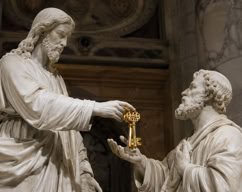
And that means was the living teaching authority of the Church. Such a teacher can enable us to know the truth and achieve the unity for which Jesus prayed. This is precisely the arrangement we find in the New Testament. Jesus established his Church as the “pillar and foundation of the truth” (1 Timothy 3:15), built upon the “foundation of the apostles and prophets” (Ephesians 2:20). He gave Simon Peter, whom he named “rock,” a distinctive position of authority among the apostles (Matthew 16:18–19; see “I Tell You That You Are Peter”).
Jesus instructed his followers to listen to the Church (Matthew 18:17), and the New Testament commands Christians to obey their spiritual leaders (Hebrews 13:17). Jesus authorized his apostles to teach in his name, declaring, “Whoever listens to you listens to me; whoever rejects you rejects me” (Luke 10:16). He commissioned them to teach all nations (Matthew 28:18–20) and gave them authority to bind and loose (Matthew 16:19, 18:18).
And this authority was not intended to disappear when the apostles died. Writing near the end of the first century, Clement of Rome explained that the apostles had provided for successors who would continue their ministry:
Our apostles knew through our Lord Jesus Christ that there would be strife for the office of bishop. For this reason, therefore, having received perfect foreknowledge, they appointed those who have already been mentioned and afterwards added the further provision that, if they should die, other approved men should succeed to their ministry.2
Irenaeus, who had learned the faith from Polycarp, a disciple of the apostle John, likewise emphasized the authority of those who succeeded the apostles:
[I]t is incumbent to obey the presbyters who are in the Church—those who, as I have shown, possess the succession from the apostles; those who, together with the succession of the episcopate, have received the infallible charism of truth, according to the good pleasure of the Father. … The true knowledge is the doctrine of the apostles, and the ancient organization of the Church throughout the whole world, and the manifestation of the body of Christ according to the succession of bishops, by which succession the bishops have handed down the Church which is found everywhere.3
Without a visible, earthly teaching authority capable of settling doctrinal disputes, disagreements can continue indefinitely. Luther could disagree with Zwingli, Calvin with other Reformers, and each could appeal to Scripture in defense of his position. But who had the authority to decide between them? Obviously, no one, because those disputes continue to this day.
As a Protestant, I had to ask myself some tough questions: Does Protestantism look like the work of him who is not the author of confusion, or does it look like the work of man? If the Holy Spirit were going to reform the Church, would he do it by establishing competing churches that disagreed about what Christians must believe, with no common authority capable of resolving their disagreements? I remembered that Jesus took pity on the crowds because they were like sheep without a shepherd. Would he have left them as orphans, to be tossed back and forth by the waves, and blown here and there by every wind of teaching?
We all know what Jesus said, but did he leave us no means of knowing what he meant by what he said? Indeed he did. For centuries, Christians understood the Church as a visible community with identifiable leaders who preserved and transmitted the teaching of the apostles. But today, how is the honest, unsophisticated seeker of truth supposed to sort through all the confusion of Protestant sectarianism and arrive at the truth? How can the average believer evaluate the conflicting claims of the myriad denominations?
The difference between the Protestant model of sola Scriptura and the Catholic model of apostolic authority can be illustrated by a classroom. Imagine two classrooms, each equipped with perfectly accurate textbooks.
In the first classroom, the students have no teacher with the authority to settle disagreements about what the textbooks mean. They can study the books, discuss them with one another, and offer competing interpretations. But if they disagree about what the books actually teach, there’s no one to settle the dispute.
In the second classroom, the students have both the textbooks and an authoritative teacher. If they misunderstand something, they can ask the teacher for clarification. If they disagree with one another, the teacher can explain the correct interpretation. And if students don't even realize they've misunderstood something, the teacher can correct them.
The Catholic model doesn't mean that every Christian will understand everything correctly, or that disagreements will never arise. But it does provide a living teaching authority capable of correcting misunderstandings and settling disputes about matters of faith. And because that authority exists independently of each believer's private judgment, it provides a foundation for the visible unity Christ desired.
And I think that's why Jesus set things up the way he did.
__________
1 David F. Payne, “The Text and Canon of the New Testament,” International Bible Commentary, ed. F. F. Bruce (Grand Rapids, MI: Zondervan Publishing House, 1986), 1005.
2 Clement of Rome, Letter to the Corinthians 44:1–2 (c. A.D. 96). See William A. Jurgens, The Faith of the Early Fathers, vol. 1 (Collegeville, MN: Liturgical Press, 1970), 10.
3 Irenaeus, Against Heresies 4.26.2; 4.33.8 (c. A.D. 180).
Featured Articles
Copyright © 2024–[YEAR] Catholicoutlook.me